 By Angela Thomas
Over 80% of European consumers indicate they are willing to pay more for sustainably sourced products, a statistic that shows the deep shift in market expectations for brands operating within the EU. This consumer sentiment, coupled with stringent new regulations like the EU Deforestation Regulation (EUDR), means that a proactive content strategy isn’t just beneficial for brands, it’s essential for demonstrating responsible leadership and maintaining market access. How can businesses effectively communicate their compliance and commitment to ethical sourcing in this new era?
Key Takeaways
- Brands must implement strong traceability systems to track commodity origins down to the geolocation of the plot of land.
- Digital content, including interactive maps and supplier profiles, will become critical for transparently demonstrating EUDR compliance to consumers and regulators.
- Regular audits and third-party certifications, verifiable through online platforms, build trust and validate responsible sourcing claims.
- Educational content on deforestation risks and mitigation efforts can position brands as industry leaders committed to sustainability.
- Proactive communication about compliance efforts can transform regulatory challenges into a distinct competitive advantage.
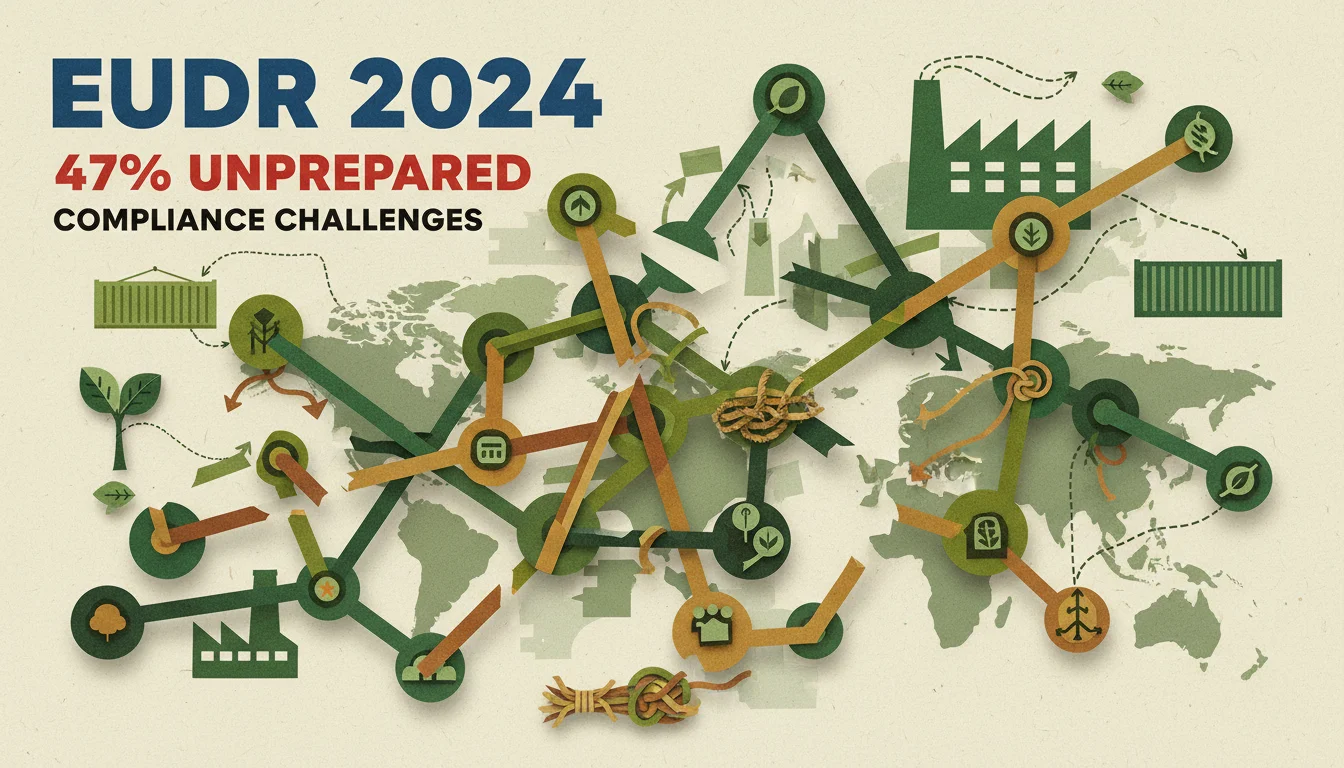
47% of EUDR-impacted businesses are not yet fully prepared for compliance by the December 2024 deadline
This figure, from a recent ChainPoint survey, is alarming. It highlights a significant disconnect between awareness of the EUDR and the practical implementation required. Many businesses, particularly small and medium-sized enterprises (SMEs), still grapple with the sheer complexity of tracing their supply chains down to the plot of land where commodities like palm oil, soy, coffee, cocoa, timber, rubber, and cattle were produced. The regulation demands verifiable proof that products have not contributed to deforestation after December 31, 2020. This isn’t a mere paperwork exercise. It requires deep integration of data across often fragmented global supply networks. My interpretation is that many companies underestimate the technological and logistical overhaul necessary. They may have a general understanding of their suppliers, but lack the granular, geolocated data necessary to satisfy the regulation’s strict requirements. This unpreparedness creates a substantial risk of market exclusion or hefty fines, which can reach up to 4% of a company’s annual EU turnover.
The average consumer spends just 7 seconds evaluating a brand’s sustainability claims online
Seven seconds. That’s the window we have to convey authenticity and compliance. This data point, derived from various eye-tracking studies on e-commerce behavior, forces a fundamental rethink of how brands present their sustainability efforts. Dense reports and lengthy policy documents, while necessary for regulators, simply will not resonate with the average shopper. Our content strategy must pivot towards immediate, verifiable proof. Think interactive dashboards showing supply chain transparency, short video testimonials from farmers, or clear infographics explaining the journey of a product from forest to shelf. The challenge is to distill complex compliance data into digestible, trustworthy formats. We need to move beyond generic “green” messaging and provide tangible evidence that stands up to scrutiny. A simple QR code on packaging that links directly to a product’s deforestation-free certification, for instance, offers instant validation. This isn’t about telling people you’re sustainable. It’s about showing them, quickly and convincingly.
Geospatial data integration is cited by 62% of businesses as their biggest technical hurdle for EUDR compliance
The complexity of integrating geospatial data is often underestimated. Companies need to collect precise latitude and longitude coordinates for all their production plots, then cross-reference this information with satellite imagery and land-use change data to prove non-deforestation. This isn’t a task for a single department. It requires collaboration between procurement, IT, and sustainability teams. Many existing enterprise resource planning (ERP) systems were not designed to handle this level of geographic specificity or to integrate with remote sensing platforms. A Statista report indicates the global geospatial analytics market is experiencing rapid growth, but adoption within specific supply chain contexts remains nascent for many. The conventional wisdom often focuses on the “what” of EUDR (e.g., “don’t source from deforested land”), but overlooks the “how” (e.g., “how do we technically verify every single plot?”). My professional experience suggests that investing in specialized platforms that can ingest, process, and visualize geospatial data is no longer a luxury. It’s a foundational requirement. Without it, companies are essentially trying to navigate a dense forest blindfolded.
Brand trust increases by 35% when companies provide verifiable evidence of ethical sourcing
This finding, from a HubSpot research study on consumer behavior, highlights the immense opportunity embedded within the EUDR challenge. While compliance is often viewed as a burden, it also presents a powerful avenue for building brand equity. When consumers see verifiable evidence, such as certifications from organizations like the Forest Stewardship Council (FSC) or the Roundtable on Sustainable Palm Oil (RSPO), their perception of the brand shifts positively. This isn’t just about avoiding penalties. It’s about cultivating a loyal customer base that values your commitment to sustainability. Content showing these certifications, perhaps through dedicated landing pages detailing the audit process or short videos explaining what each certification entails, can be incredibly effective. It moves beyond generic claims to concrete proof, which resonates deeply with the modern, environmentally conscious consumer. This is where responsible leadership truly shines, transforming regulatory necessity into a compelling brand narrative.
Only 15% of consumers believe companies are truly transparent about their environmental impact
This low percentage, revealed in a recent Nielsen global sustainability report, represents a deep trust deficit. Despite widespread corporate sustainability initiatives and marketing efforts, consumers remain skeptical. This skepticism isn’t unfounded. It stems from years of greenwashing and vague corporate pronouncements. The EUDR, with its strict traceability and due diligence requirements, offers a unique mechanism to bridge this trust gap. For brands, this means moving beyond glossy reports to granular, verifiable data. Instead of simply stating “we are committed to sustainability,” a responsible content strategy would articulate exactly how that commitment is fulfilled, backed by specific data points. For instance, a brand could publish aggregated, anonymized data on the deforestation-free status of its entire supply chain for a given commodity, updated quarterly. This level of transparency, while initially daunting, directly addresses consumer skepticism and builds genuine credibility. It’s an opportunity to truly differentiate in a crowded market.
The EUDR isn’t just a regulatory hurdle. It’s a catalyst for fundamental shifts in supply chain management and consumer communication. Brands that embrace the challenge with a strong, data-driven content strategy will not only achieve compliance but also build stronger, more trusted relationships with their customers. This isn’t merely about avoiding fines. It’s about securing future market relevance and demonstrating true responsible leadership in a world increasingly demanding ethical business practices.
What is the primary goal of the EU Deforestation Regulation (EUDR)?
The primary goal of the EUDR is to ensure that products consumed within the European Union do not contribute to global deforestation or forest degradation, aiming to reduce the EU’s impact on climate change and biodiversity loss worldwide.
Which commodities are covered by the EUDR?
The EUDR covers seven key commodities: palm oil, soy, coffee, cocoa, timber, rubber, and cattle. It also extends to products derived from these commodities, such as chocolate, furniture, and tires.
What kind of content should companies develop to demonstrate EUDR compliance?
Companies should develop transparent content like interactive supply chain maps, detailed supplier profiles, verifiable third-party certifications, educational materials on their due diligence processes, and real-time dashboards showing deforestation-free sourcing data.
How does geospatial data relate to EUDR compliance?
Geospatial data, specifically latitude and longitude coordinates of production plots, is critical for EUDR compliance. Businesses must use this data, combined with satellite imagery, to prove that their sourced commodities did not originate from land deforested after December 31, 2020.
What are the potential consequences for non-compliance with the EUDR?
Non-compliance with the EUDR can lead to significant penalties, including substantial fines (up to 4% of a company’s annual EU turnover), confiscation of products, exclusion from public procurement processes, and severe reputational damage.


