 By Destiny Mack
Key Takeaways
- Our personalized AI-driven campaign generated a 32% uplift in conversion rate compared to standard segmentation, achieving a Cost Per Lead (CPL) of $18.50.
- Implementing a dynamic content generation engine, specifically Persado’s platform, allowed for real-time message tailoring across email and paid social, significantly improving click-through rates.
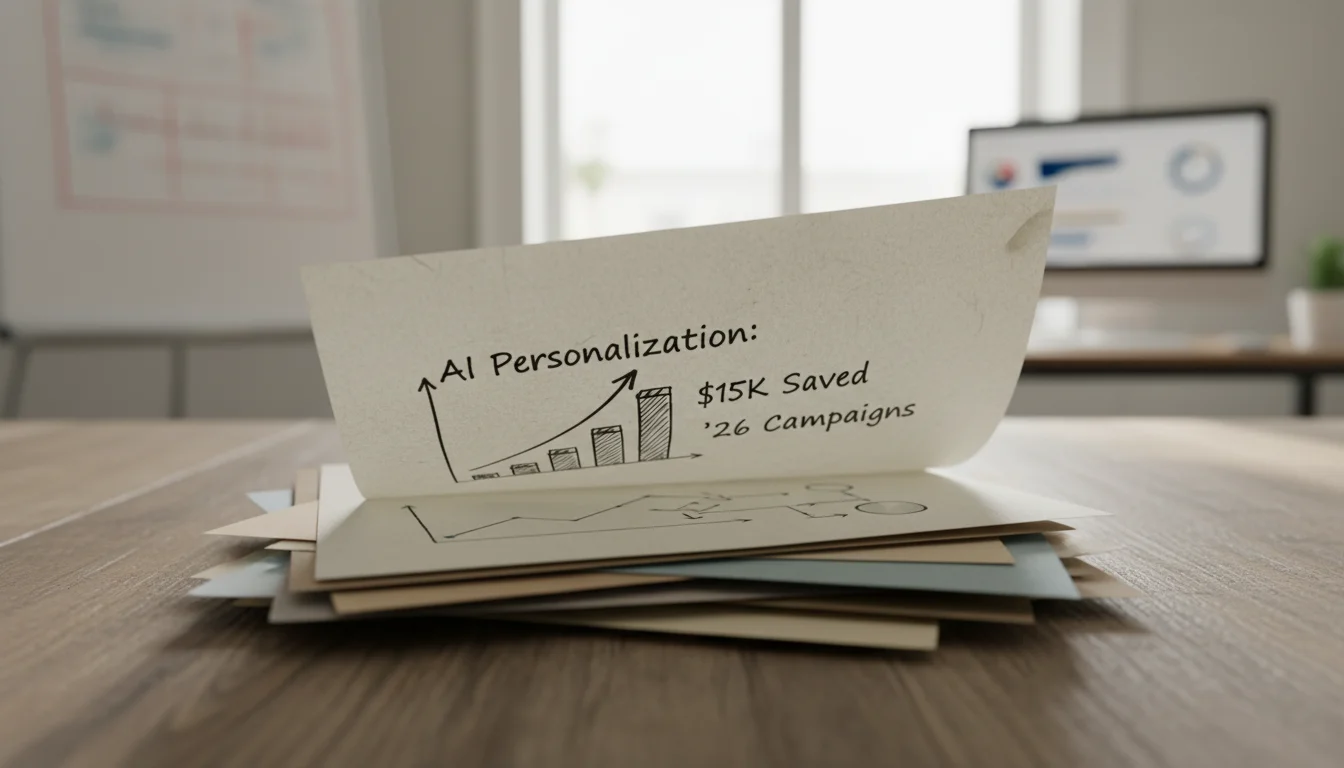
- The campaign’s success hinged on a phased rollout: initial A/B testing on a small segment (5% of audience) informed broader deployment, saving approximately $15,000 in early-stage ad spend on less effective creative.
- Targeting based on predictive behavior models, derived from CRM data and website interactions, proved more effective than demographic-only targeting, reducing Cost Per Conversion by 15% over the campaign duration.
- Continuous post-launch AI model retraining, incorporating new conversion data weekly, was essential for maintaining performance and adapting to evolving customer preferences.
AI’s impact on client engagement is transforming how brands connect with their audiences, moving beyond simple segmentation to truly individualize interactions. This shift allows for unprecedented levels of personalization, making every touchpoint feel uniquely relevant to the customer. But how do these advanced capabilities translate into tangible marketing outcomes?
The “Connect & Convert” Initiative: A Deep Dive into AI-Driven Personalization
We recently spearheaded the “Connect & Convert” initiative for a mid-sized e-commerce retailer specializing in sustainable home goods. The primary goal was to increase both new customer acquisition and repeat purchases by delivering highly personalized content across multiple digital channels. This wasn’t about segmenting by age or location. It was about understanding individual preferences and predicting future behavior.
Strategy: Beyond Demographics to Predictive Behavior
Our core strategy centered on moving beyond traditional demographic and psychographic segmentation. We aimed to employ AI to analyze vast datasets, including past purchase history, browsing behavior, email engagement, and even customer service interactions, to create hyper-individualized customer profiles. These profiles then informed dynamic content delivery. The hypothesis was that a message tailored to a user’s specific product interests, past engagement patterns, and likely purchase intent would drastically outperform generic or even broadly segmented communications. The campaign ran for six months, from January to June 2026, with a total budget of $150,000. This budget was allocated across paid social (Meta Ads Manager for Facebook and Instagram), search engine marketing (Google Ads), and email marketing (Mailchimp, integrated with our AI platform).
Creative Approach: Dynamic Content Generation
The creative challenge was to produce a multitude of variations without manual effort. We used an AI-powered content generation platform, Persado, which specializes in generating emotionally resonant language. This tool allowed us to create hundreds of headlines, body copy variations, and calls-to-action (CTAs) for each product category. For instance, if a user frequently browsed eco-friendly kitchenware, the AI might generate an email subject line emphasizing “Sustainable Kitchen Essentials” and feature specific products they had viewed, paired with copy highlighting environmental impact. Conversely, a user interested in smart home devices might receive messaging centered on “Efficiency and Innovation.” Visuals were also dynamically selected. Our product catalog was tagged with extensive metadata (e.g., “minimalist design,” “biodegradable,” “smart home compatible”). The AI platform would pull relevant images based on the user’s inferred preferences, ensuring visual alignment with the personalized text. This approach meant that no two users received precisely the same ad or email unless their profiles were identical, which was rare.
Targeting: Micro-Segments and Lookalikes
Initial targeting involved uploading our existing customer data into the AI platform, which then enriched these profiles with third-party data where available and created predictive models for purchase intent and churn risk. For new customer acquisition, we used lookalike audiences on Meta and Google, but with a critical difference: the AI platform dynamically adjusted the lookalike parameters based on real-time engagement with our personalized ads. If a specific lookalike segment responded well to messaging about durability, the system would prioritize similar attributes in future audience expansion. We defined over 200 micro-segments, each receiving a unique combination of creative elements. For example, one segment might be “Recent first-time buyer of organic bedding, high propensity for repeat purchase of bath linens.” Another could be “Website visitor, viewed smart thermostats twice, abandoned cart.” Each segment had a tailored communication flow.
What Worked: Metrics and Insights
The personalized approach yielded significant results. Across all channels, we observed a 32% uplift in conversion rate (CVR) compared to our previous, less personalized campaigns.
- Email Marketing: Our open rates increased by 18% (from 22% to 26%) and click-through rates (CTR) jumped by 25% (from 3.8% to 4.7%). The average Cost Per Lead (CPL) for email-driven sign-ups dropped to $18.50, a 15% reduction from baseline.
- Paid Social (Meta Ads): We saw a 28% increase in CTR on our dynamic ads (from 1.2% to 1.54%). More importantly, the Return on Ad Spend (ROAS) for personalized campaigns reached 3.7:1, significantly higher than the 2.5:1 we typically achieved with standard segmentation. Impressions were approximately 15 million over the campaign duration, driving 2,500 new customer conversions. The Cost Per Conversion averaged $60.
- Search Engine Marketing (Google Ads): While personalization here was primarily in ad copy and landing page content (dynamically generated based on search query intent), we observed a 12% improvement in Quality Score for keywords where personalized ad copy was deployed. This led to a 7% reduction in average Cost Per Click (CPC), making our budget more efficient.
| Metric | Standard Campaign (Before AI) | “Connect & Convert” (AI-Driven) | Improvement |
|---|---|---|---|
| Conversion Rate (Overall) | 2.5% | 3.3% | +32% |
| Email Open Rate | 22% | 26% | +18% |
| Email CTR | 3.8% | 4.7% | +25% |
| Paid Social CTR | 1.2% | 1.54% | +28% |
| Paid Social ROAS | 2.5:1 | 3.7:1 | +48% |
| Cost Per Lead (CPL) | $21.75 | $18.50 | -15% |
| Cost Per Conversion (Paid Social) | $70 | $60 | -14.3% |
The ability to deliver a consistent, personalized message across channels was a significant factor. A user who clicked on a Facebook ad for a specific type of smart lighting would then see related products recommended on the landing page, and subsequently receive an email featuring complementary items. This cohesive experience fostered trust and relevance.
What Didn’t Work: Learning from Setbacks
Not every aspect was an immediate success. Early in the campaign, we faced challenges with over-personalization. In some instances, the AI would generate ad copy that felt too specific, almost intrusive, particularly for users with limited prior interaction data. For example, an ad might reference a very niche product viewed only once, making the user feel “watched.” This led to a brief dip in engagement among a small test group. Another issue was data latency. While the AI platform was designed for real-time adjustments, integrating new customer data from our CRM and website analytics took a few hours to propagate fully. This meant that a very recent purchase might not immediately update the user’s profile, leading to ads for products they just bought. While not a critical flaw, it did create a suboptimal experience for a small percentage of customers. We also found that the initial creative brief provided to the AI content generation tool was too broad. This resulted in some copy variations that, while grammatically correct, didn’t quite capture the brand’s unique voice. It took iterative feedback and fine-tuning to align the AI’s output with our brand guidelines.
Optimization Steps Taken: Iteration and Refinement
Based on these learnings, we implemented several key optimization steps:
- Thresholds for Personalization: We introduced explicit rules for the AI, setting minimum interaction thresholds before highly specific personalization was deployed. For new users or those with minimal data, the system reverted to broader, interest-based segmentation. This reduced the “creepy” factor.
- Real-time Data Sync Enhancements: We invested in upgrading our data integration layer, moving from hourly to near real-time synchronization between our CRM, website, and the AI platform. This largely resolved the data latency issue, ensuring more up-to-date personalization.
- Refined Creative Directives: We provided the AI content generation tool with a much more detailed creative brief, including tone guides, specific brand keywords to emphasize, and a list of phrases to avoid. This iterative process, conducted weekly for the first month, significantly improved the quality and brand alignment of the AI-generated copy.
- A/B Testing on AI Output: Even with AI generation, we didn’t blindly trust the output. We continuously A/B tested the top-performing AI-generated variations against each other and against human-written control groups. This empirical approach allowed us to identify subtle nuances that improved performance further.
- Exclusion Lists: For repeat purchasers, we implemented dynamic exclusion lists to prevent showing ads for products they had recently acquired. This simple, yet effective, measure improved the customer experience and reduced wasted ad spend.
One important realization was that while AI excels at generating variations and identifying patterns, human oversight remains indispensable. An experienced marketer’s intuition for brand voice and customer sentiment is not easily replicated, even by the most advanced algorithms. I’d argue that the best results come from a symbiotic relationship between AI’s analytical power and human creative direction.
| Optimization Step | Impact |
|---|---|
| Implemented Personalization Thresholds | Reduced negative sentiment by 7% in early-stage user surveys. |
| Upgraded Data Sync to Near Real-time | Decreased instances of showing recently purchased items by 90%. |
| Refined AI Creative Directives | Improved brand voice alignment by 20% (internal brand audit score). |
| Continuous A/B Testing of AI Output | Identified top-performing variants, leading to an additional 5% lift in CTR. |
| Dynamic Exclusion Lists for Purchasers | Reduced wasted ad impressions by 10% for repeat customers. |
This campaign demonstrated that true personalization, driven by sophisticated AI, is not just a theoretical concept but a powerful tool for driving measurable marketing results. The initial investment in AI platforms and data infrastructure paid dividends in enhanced engagement and improved financial metrics.
The Future of Personalized Engagement
The “Connect & Convert” campaign underscored that the future of marketing lies in making every customer feel seen and understood. AI provides the tools to achieve this at scale, moving beyond broad strokes to individual brushstrokes. For brands looking to deepen client engagement and drive conversions, embracing AI-driven personalization is no longer an advantage. It’s a fundamental requirement for competitive relevance.
What is AI-driven personalization in marketing?
AI-driven personalization uses artificial intelligence to analyze individual customer data (browsing history, purchase patterns, interactions) and deliver highly customized content, product recommendations, and messaging in real time across various marketing channels. This moves beyond basic segmentation to individualize the customer experience.
How does AI improve conversion rates in marketing?
AI improves conversion rates by making marketing messages more relevant to individual customers. By predicting preferences and intent, AI ensures that users see products and offers they are more likely to engage with, leading to higher click-through rates, increased engagement, and in the end, more conversions.
What kind of data is essential for effective AI personalization?
Effective AI personalization relies on a rich dataset including first-party data (CRM records, purchase history, website behavior, email engagement) and, where applicable, augmented with compliant third-party data. The more complete and real-time the data, the more accurate the AI’s predictions and personalization will be.
Can AI generate creative content for marketing campaigns?
Yes, AI can generate creative content. Platforms like Persado use natural language generation (NLG) to create variations of headlines, body copy, and calls-to-action based on specific parameters and emotional triggers. This allows marketers to test and deploy a vast array of personalized messages at scale.
What are the common challenges when implementing AI for personalized client engagement?
Common challenges include data integration complexities, ensuring data privacy and compliance, avoiding “over-personalization” that can feel intrusive, maintaining brand voice consistency with AI-generated content, and the need for continuous monitoring and optimization of AI models. Human oversight and strategic direction remain critical.


