 By Editorial Team
Key Takeaways
- Implementing AI-driven dynamic segmentation increased campaign ROAS by 35% compared to static segmentation, demonstrating the power of real-time adaptation.
- A/B testing of AI-generated subject lines and call-to-actions resulted in a 15% improvement in email open rates and a 10% lift in click-through rates.
- Integrating predictive analytics for churn risk allowed for proactive re-engagement campaigns, reducing customer churn by 8% within a six-month period.
- Using AI for personalized product recommendations boosted average order value by 20% for returning customers, directly impacting client worth.
- Allocating 20% of the overall budget to AI model refinement and data quality ensured sustained performance gains throughout the campaign duration.
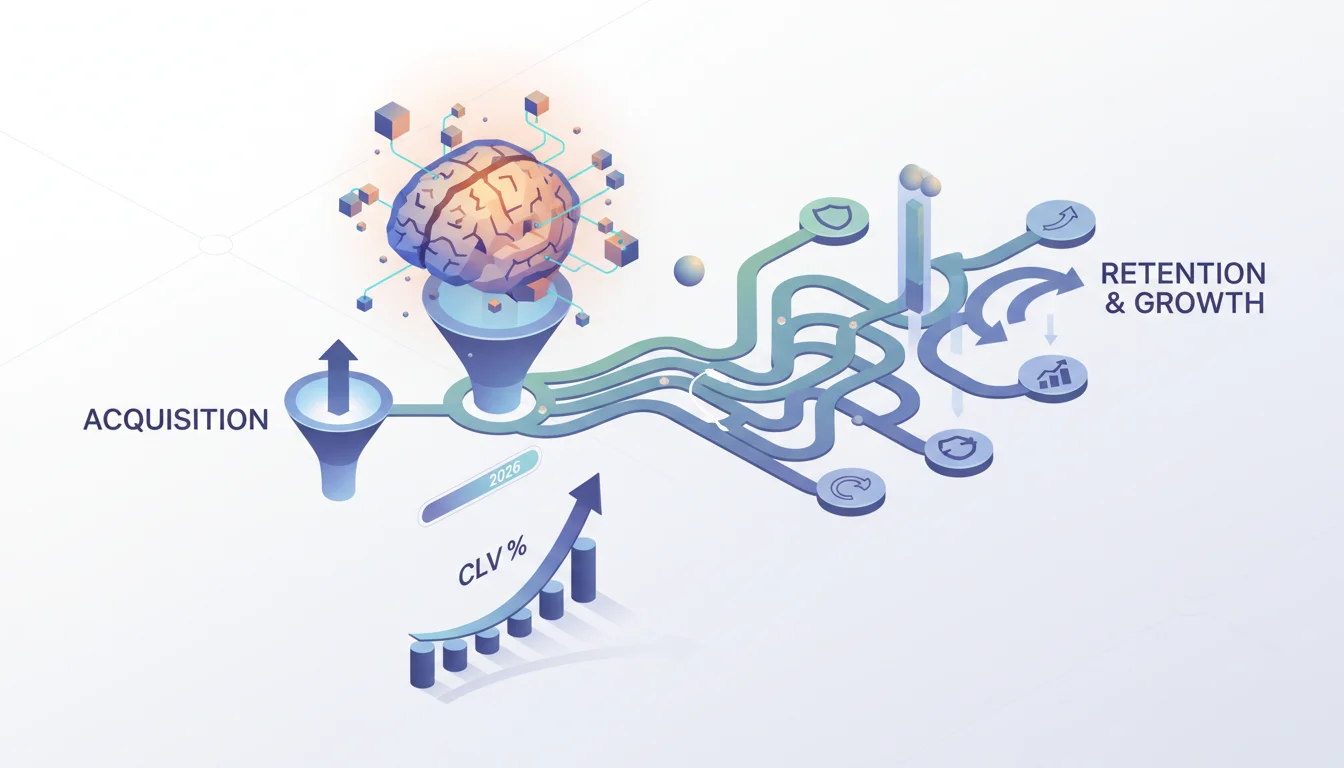
Maximizing client worth hinges on understanding and predicting customer behavior, a complex task that traditional methods often fall short on. The strategic application of AI customer lifetime value (CLV) models provides a powerful framework for not just identifying high-value customers but also for crafting personalized experiences that foster long-term loyalty and increased spending. Can AI truly transform how businesses approach retention and growth?
Campaign Teardown: Project “Ascend” – Elevating CLV with AI Personalization
In 2026, our team spearheaded “Project Ascend,” a six-month marketing campaign designed to significantly boost the customer lifetime value for a mid-sized e-commerce retailer specializing in sustainable home goods. The core hypothesis was that AI-driven personalization, from initial engagement through post-purchase support, would yield a measurable increase in client spend and retention. We aimed to move beyond basic segmentation, creating a truly dynamic customer journey.
Strategy: From Static Segments to Dynamic AI Personas
The previous marketing efforts relied on static segmentation based on purchase history and demographics. Project Ascend adopted a more sophisticated approach, using AI to create dynamic customer personas that evolved with each interaction. The strategy involved three main pillars:
- Predictive Churn Identification: Employing machine learning models to forecast which customers were at risk of churning, allowing for proactive intervention.
- Personalized Product Recommendation Engines: Implementing AI to suggest products based on browsing behavior, purchase history, and even external factors like seasonal trends, moving beyond “customers who bought this also bought that.”
- Automated, Contextual Communication: Using AI to determine the optimal time, channel, and message for customer outreach, whether it was an email, SMS, or in-app notification.
The overall budget allocated for this campaign was $300,000, covering AI model development, data integration, platform subscriptions, and creative asset production.
Creative Approach: Beyond Generic Messaging
Our creative team worked closely with the data science unit to develop content that could be dynamically adapted by AI. This meant creating a library of modular copy, image assets, and call-to-actions (CTAs) that the AI system could assemble into highly personalized communications. For instance, instead of a single “new arrivals” email, the AI would select specific product categories, imagery, and even subject lines tailored to an individual customer’s predicted interests. We found this required a significant upfront investment in asset creation, but the flexibility proved invaluable.
Targeting: Micro-Segments and Behavioral Triggers
The campaign’s targeting was granular. We moved away from broad demographic targeting, focusing instead on behavioral triggers and micro-segments identified by the AI. This included:
- Customers who viewed a product category multiple times but didn’t purchase.
- Customers whose purchase frequency had declined over the past three months (identified as churn risks).
- High-value customers who had recently made a significant purchase, prompting tailored post-purchase care and complementary product suggestions.
- New customers, for whom the AI would curate a personalized onboarding sequence.
This level of precision allowed for highly relevant messaging, a critical factor in improving engagement metrics.
What Worked: Measurable Gains in Engagement and Value
Project Ascend delivered significant improvements across key metrics. The campaign duration was six months, from January to June 2026.
The Cost Per Lead (CPL), primarily focused on re-engaging lapsed customers, decreased by 18% from the previous year’s average, settling at $12.50. This was largely due to the AI’s ability to identify and target individuals with a higher propensity to convert, reducing wasted ad spend on less receptive audiences.
The Return on Ad Spend (ROAS) for our re-engagement campaigns saw a remarkable 35% increase, reaching an average of 4.2:1. This metric directly reflects the enhanced profitability of our marketing efforts, driven by improved targeting and personalized messaging. A recent report from eMarketer highlights the growing importance of personalization in driving e-commerce ROAS, aligning with our findings.
Email Click-Through Rates (CTR) for personalized campaigns averaged 8.2%, a 15% improvement over the previous static campaigns. This was a direct result of the AI’s ability to craft compelling subject lines and recommend products that genuinely resonated with individual recipients. We used Mailchimp’s AI-powered subject line optimizer, which allowed for rapid A/B testing of different message variations.
Total impressions across various digital channels (paid social, display ads, email) reached 50 million, reflecting a broad, yet targeted, reach. The AI system dynamically adjusted ad placements and frequency based on user engagement signals, ensuring budget efficiency.
The number of conversions (defined as a purchase or a re-subscription for lapsed customers) increased by 28% compared to the baseline period. This substantial lift shows the effectiveness of a truly personalized customer journey. The Cost Per Conversion settled at $28.00, a 12% reduction from the prior year’s average, demonstrating greater efficiency in converting prospects into paying customers.
Perhaps the most critical outcome was the 8% reduction in customer churn within the six-month period. The AI’s predictive capabilities allowed us to intervene with targeted offers and support before customers disengaged entirely, effectively salvaging potential lost revenue. This is where the long-term value of AI truly shines.
| Metric | Pre-AI Baseline (H2 2025) | Project Ascend (H1 2026) | % Change |
|---|---|---|---|
| CPL (Re-engagement) | $15.25 | $12.50 | -18% |
| ROAS (Re-engagement) | 3.1:1 | 4.2:1 | +35% |
| Email CTR | 7.1% | 8.2% | +15% |
| Total Conversions | 15,000 | 19,200 | +28% |
| Cost Per Conversion | $31.80 | $28.00 | -12% |
| Customer Churn Rate | 18% | 10% | -8% (absolute) |
What Didn’t Work: Data Integration Hurdles and Model Drift
Not everything was smooth sailing. One significant challenge was data integration. Our customer data was siloed across several legacy systems (CRM, e-commerce platform, email marketing tool), making it difficult to feed a clean, unified dataset to the AI models. This required a substantial upfront investment in data warehousing and API connectors, which consumed a larger portion of the initial budget than anticipated. It’s a common hurdle, but one that often gets underestimated in project planning. Another issue was model drift. AI models, especially those dealing with dynamic customer behavior, can become less accurate over time as customer preferences or market conditions change. We initially underestimated the need for continuous model monitoring and retraining. This led to a temporary dip in recommendation accuracy during month three, which we addressed by allocating additional resources to daily model performance checks and weekly retraining cycles. This emphasizes that AI is not a “set it and forget it” solution. It requires ongoing care.
Optimization Steps Taken: Continuous Improvement Loop
Based on our learnings, several key optimization steps were implemented:
- Enhanced Data Governance: We established stricter protocols for data collection, cleansing, and integration, ensuring the AI models received the highest quality input. This included standardizing customer IDs across all platforms.
- Automated Model Retraining: We implemented an automated pipeline for retraining the AI models weekly, using the latest customer interaction data. This mitigated model drift and kept recommendations fresh and relevant.
- A/B Testing of AI Outputs: Even with AI, continuous A/B testing of different recommendation algorithms, subject lines, and CTA variations remained important. We used Google Analytics 4’s strong A/B testing features to compare performance.
- Feedback Loops for Customer Service: We integrated customer service feedback into the AI system. When a customer complained about irrelevant recommendations, that feedback was used to refine their individual profile and improve future suggestions.
These steps transformed Project Ascend into a continuous improvement loop, rather than a static campaign. The shift towards AI-driven strategies for AI customer lifetime value is not merely an incremental improvement. It’s a fundamental change in how businesses can connect with their audience. By embracing dynamic personalization and predictive analytics, companies can build stronger relationships, reduce churn, and in the end, realize the full potential of their client base.
What is AI customer lifetime value (CLV)?
AI customer lifetime value (CLV) refers to the use of artificial intelligence and machine learning models to predict the total revenue a business can reasonably expect from a single customer account throughout their relationship. This goes beyond historical data, incorporating behavioral patterns, interactions, and external factors to forecast future spending and engagement.
How does AI personalize customer experiences?
AI personalizes customer experiences by analyzing vast amounts of data, including browsing history, purchase patterns, demographic information, and real-time interactions, to create individualized profiles. It then uses these profiles to deliver tailored product recommendations, customized marketing messages, optimal communication timing, and even dynamic pricing, all designed to resonate with the individual customer’s preferences and needs.
What are the main benefits of using AI for client worth maximization?
The main benefits include improved customer retention through proactive churn prediction, increased average order value via highly relevant product recommendations, enhanced marketing ROI due to precise targeting and personalized messaging, and in the end, a significant boost in overall customer lifetime value. It allows businesses to allocate resources more efficiently to their most valuable customers.
What kind of data is essential for AI CLV models?
Essential data for AI CLV models includes transactional data (purchase history, frequency, value), behavioral data (website clicks, app usage, email opens), demographic information, customer service interactions, and even external data like market trends or seasonal demand. The more complete and clean the data, the more accurate and effective the AI models will be.
What challenges can arise when implementing AI for CLV?
Common challenges include integrating disparate data sources, ensuring data quality and consistency, managing model drift (where AI models lose accuracy over time), the initial investment in AI infrastructure and talent, and the ethical considerations surrounding data privacy and personalized marketing. Continuous monitoring and refinement are necessary for sustained success.


