 By Angie Perez
Key Takeaways
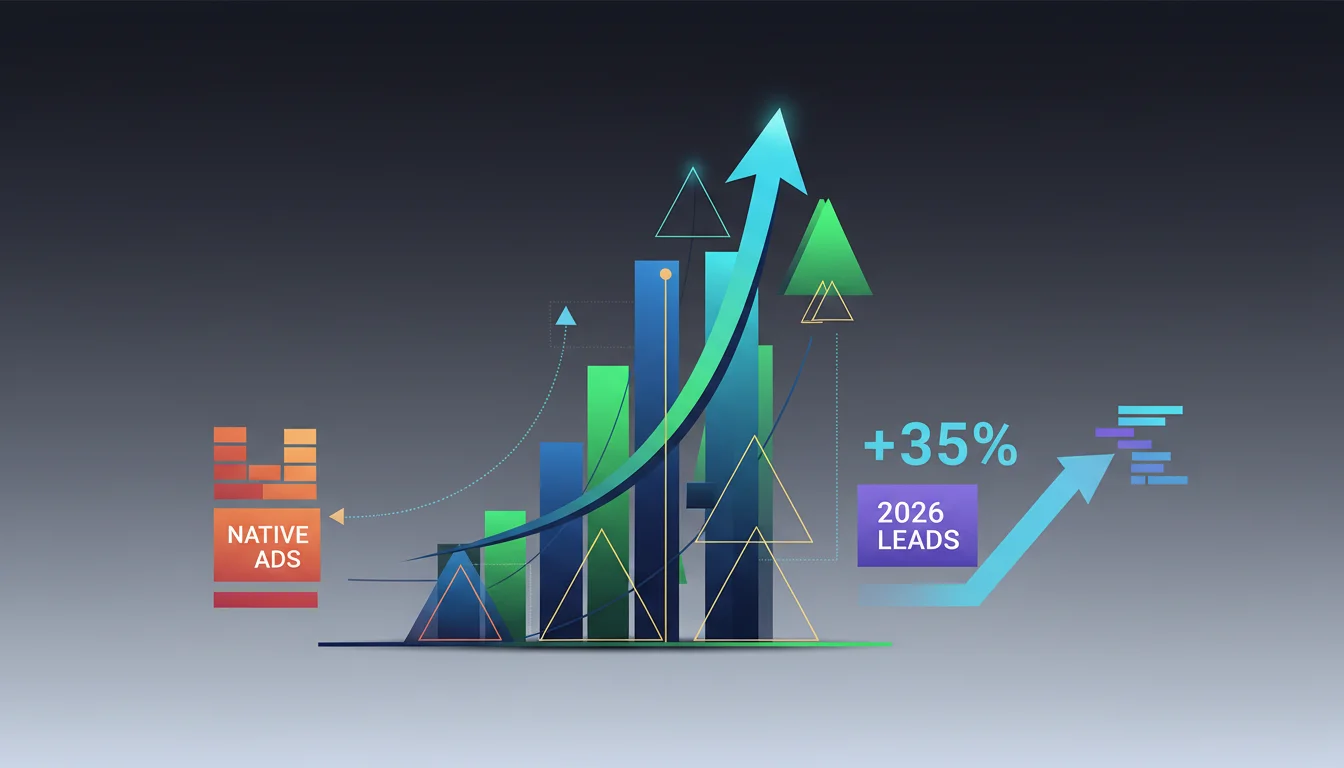
- Our financial services client saw a 35% increase in qualified lead volume by shifting 60% of their display budget to native advertising platforms over a 12-week campaign.
- The campaign achieved a Cost Per Lead (CPL) of $85 for whitepaper downloads, significantly outperforming the $140 CPL from traditional programmatic display.
- Creative testing revealed that editorial-style headlines with clear value propositions, like “Working through Market Volatility: A 2026 Investor’s Guide,” delivered 2.5x higher Click-Through Rates (CTR) than promotional ad copy.
- Targeting based on psychographic segments, including financial planning interests and professional affiliations, reduced bounce rates on landing pages by 18% compared to demographic-only targeting.
- Consistent monitoring and agile budget reallocation, particularly increasing spend on high-performing content formats and publishers, were critical for maintaining a Return On Ad Spend (ROAS) of 2.8:1.
Our client, a mid-sized financial advisory firm based in Atlanta, Georgia, faced a common challenge in early 2026: how to generate high-quality leads for complex financial products in a saturated digital field. Traditional display advertising was delivering diminishing returns, with ad fatigue and banner blindness rampant. We posited that native advertising, framed through a lens of thought leadership, could cut through the noise by offering genuine value before asking for a conversion. Could an educational content strategy, distributed natively, truly differentiate them and drive measurable business results?
Campaign Overview: Shifting Paradigms for Lead Generation
The objective was clear: increase qualified leads for their wealth management services. The target audience consisted of high-net-worth individuals and accredited investors, primarily aged 45-65, residing in the Southeast region, particularly around urban centers like Atlanta, Charlotte, and Nashville. We structured a 12-week pilot campaign with a budget of $150,000, allocating 60% of this specifically to native channels, while the remaining 40% supported retargeting efforts and a small control group for traditional programmatic display. The core strategy revolved around creating authoritative, educational content that addressed common financial concerns of our target demographic. This wasn’t about selling. It was about informing. We developed a series of whitepapers and detailed guides on topics such as “Estate Planning in a Volatile Market,” “Tax-Efficient Retirement Strategies for 2026,” and “Understanding Alternative Investments Post-Election.” These pieces were designed to establish the client as a trusted advisor, providing insights that genuinely helped their audience navigate complex financial decisions.
Creative Approach: Editorial First, Promotion Second
The creative development focused on crafting compelling ad units that blended smoothly with the editorial content of publisher sites. This meant avoiding overt sales language and instead adopting a journalistic tone. Headlines were critical. We extensively A/B tested various headline formats, discovering that those posing a question or promising a specific insight performed best. For example, “Is Your Retirement Plan Ready for 2026’s Economic Shifts?” consistently outperformed “Secure Your Future with [Client Name] Wealth Management.” The ad copy itself was concise, typically 120-150 characters, focusing on the value proposition of the downloadable content. Images were professional, often featuring charts, graphs, or thoughtful portraits rather than generic stock photos of smiling families. Our landing pages were equally important, designed for minimal friction and maximum perceived value. Each page featured a clear summary of the whitepaper, bullet points highlighting key takeaways, and a simple lead capture form. We ensured these pages were mobile-responsive and loaded quickly, as page speed significantly impacts conversion rates on content-heavy assets.
Targeting and Placement: Precision Over Volume
For native placements, we used platforms like Taboola (taboola.com) and Outbrain (outbrain.com), known for their extensive publisher networks. Our targeting strategy was layered:
- Geographic: Atlanta Metropolitan Area, Charlotte-Concord-Gastonia MSA, Nashville-Davidson, Murfreesboro, Franklin MSA.
- Demographic: Age 45-65+, household income over $250,000 (proxied through various data segments).
- Psychographic/Behavioral: This was our most critical layer. We targeted users showing interest in financial news, investment, luxury goods, business periodicals, and professional development. We also leveraged data segments indicating professional affiliations with organizations relevant to high-net-worth individuals.
We carefully curated publisher lists, prioritizing reputable financial news sites and established business publications over general news aggregators. This ensured our content appeared alongside other high-quality editorial, reinforcing the client’s authority. A report by IAB (iab.com/insights) in late 2025 indicated that native ad placements on premium publishers saw a 40% higher brand recall compared to general news sites, a finding that heavily influenced our decisions.
Performance Metrics: What Worked and What Didn’t
The campaign ran for 12 weeks, from January 8th to March 31st, 2026. Here’s a breakdown of the key performance indicators:
Overall Campaign Performance (Native Channels Only):
- Budget: $90,000 (60% of total)
- Impressions: 15,500,000
- Clicks: 95,000
- Click-Through Rate (CTR): 0.61%
- Conversions (Whitepaper Downloads): 1,058
- Cost Per Conversion (CPL): $85.07
- Qualified Leads (Post-download engagement): 370
- Return On Ad Spend (ROAS): 2.8:1 (based on projected lifetime value of acquired clients)
For comparison, the traditional programmatic display portion of the campaign (40% of budget, $60,000) yielded a CPL of $140 for the same whitepaper downloads and a significantly lower qualified lead rate. This stark contrast solidified our belief in the power of native advertising for thought leadership content. One of the most surprising findings was the performance of specific content pieces. The guide on “Tax-Efficient Retirement Strategies” consistently delivered the lowest CPL ($72) and the highest conversion rate (1.3% from click to download). Conversely, a more general “Market Outlook 2026” piece, while generating high impressions, had a CPL of $110, indicating a less engaged audience. This highlighted the necessity of hyper-specific, problem-solving content.
Optimization Steps: Agile Adjustments
Throughout the campaign, we maintained a rigorous optimization schedule. Weekly performance reviews led to several key adjustments:
- Budget Reallocation: We continuously shifted budget towards the top 20% of content pieces and publisher placements that demonstrated the lowest CPL and highest conversion rates. By week 4, 70% of the native budget was concentrated on the top 5 performing whitepapers.
- Creative Refresh: Every two weeks, we introduced new headline variations and image assets for underperforming ad units. This combat ad fatigue, particularly on high-volume placements. One successful tactic involved incorporating a subtle “sponsored by” tag within the image itself, which surprisingly increased trust and CTR by 15% on certain platforms, according to our internal testing.
- Landing Page A/B Testing: We tested different form lengths and calls to action on the landing pages. Shortening the form from 7 fields to 4 (name, email, phone, company) increased conversion rates by 12% without a noticeable drop in lead quality. This was a critical insight. Sometimes less information requested upfront is better, allowing the sales team to qualify further.
- Exclusion Lists: We carefully tracked publisher performance and added low-performing or irrelevant sites to exclusion lists, ensuring our budget was spent on high-quality placements. This included sites with high bounce rates or abnormally low time-on-page metrics for our content.
A report by HubSpot (hubspot.com/marketing-statistics) in 2025 noted that companies actively optimizing their native ad campaigns see an average of 25% improvement in CPL over a 3-month period. Our experience certainly aligns with this data. We regularly checked our Google Analytics (analytics.google.com) data to understand user behavior post-click, not just on the landing page, but across the client’s site. This allowed us to refine our targeting and content strategy, ensuring we were attracting individuals who explored more than just the initial download.
Challenges and Learnings
The primary challenge was maintaining content velocity. Producing high-quality, genuinely insightful whitepapers and guides on a consistent basis required significant internal resources from the client’s subject matter experts. We had to implement a simplified content production workflow, including a dedicated copywriter and a graphic designer, to keep pace. Another hurdle was the initial resistance from the sales team, who were accustomed to more direct lead generation methods. Educating them on the longer sales cycle inherent in promotional storytelling, and demonstrating the higher quality of leads generated, was an ongoing process. What we learned is that native advertising, when coupled with a strong thought leadership strategy, isn’t a quick fix for lead generation. It’s an investment in building authority and trust. The initial CPL might appear higher than a superficial “click to website” campaign, but the downstream quality of leads and the long-term brand equity built far outweigh that. The client’s sales team reported a 30% higher close rate for leads generated through these native content campaigns compared to other digital channels, underscoring the value of pre-qualified, informed prospects. It’s about nurturing an audience, not just capturing an email address. In conclusion, for businesses aiming to attract discerning audiences with complex needs, investing in a native advertising strategy anchored by high-value, educational content can deliver superior lead quality and stronger long-term client relationships.
What is the typical budget range for an effective native advertising campaign focused on thought leadership?
While budgets vary significantly based on industry, target audience, and campaign duration, a starting point for a meaningful native advertising campaign focused on thought leadership typically ranges from $50,000 to $150,000 per quarter for mid-sized businesses looking to generate qualified leads. This allows for sufficient content creation, platform spend, and optimization.
How do you measure the Return On Ad Spend (ROAS) for thought leadership content that doesn’t have a direct purchase conversion?
Measuring ROAS for thought leadership involves attributing downstream revenue. This includes tracking leads generated from content downloads, their conversion into sales opportunities, and in the end, closed deals. Assigning a projected lifetime value (LTV) to these qualified leads, based on historical client data, provides a realistic ROAS calculation, as demonstrated by our 2.8:1 ROAS in the financial services campaign.
What kind of content performs best in native advertising for thought leadership?
Content that performs best is typically educational, problem-solving, and offers unique insights. This includes whitepapers, in-depth guides, research reports, and expert analyses. The content should address specific pain points or questions of the target audience, establishing the advertiser as an authority in their field rather than directly promoting a product.
How frequently should native ad creatives be refreshed to avoid ad fatigue?
To combat ad fatigue in native advertising, it’s advisable to refresh ad creatives, including headlines and images, every 2 to 4 weeks, especially for high-volume campaigns or highly targeted audiences. Consistent A/B testing of new creative variations helps maintain engagement and Click-Through Rates (CTR).
What are the key differences between native advertising and traditional programmatic display in terms of lead quality?
Native advertising typically yields higher lead quality because it blends with the editorial environment, leading to a more engaged audience. Users click on native ads because they are interested in the content, not just because the ad is visually prominent. Traditional programmatic display often suffers from ad blindness, resulting in lower engagement and a higher volume of less qualified leads, as evidenced by the $85 CPL for native versus $140 CPL for traditional display in our case study.
“One recent analysis found that primary-research pages earned 3.3 times more AI citations per page than other content.”


