 By Editorial Team
Key Takeaways
- The SEA AI market’s expected $86.8 billion valuation by 2030 means it’s time to build targeted marketing plans now.
- Indonesia is way ahead on AI adoption (26% of businesses are in), so you can’t use a one-size-fits-all ASEAN strategy.
- GenAI tools are the new standard for content and engagement. Marketers who don’t master them will be left behind.
- ASEAN data privacy is a patchwork of laws. You have to comply with rules like Singapore’s PDPA or risk fines and lose customer trust.
- In Southeast Asia, micro-influencers get much better engagement and feel more authentic to local audiences than big-name macro-influencers.
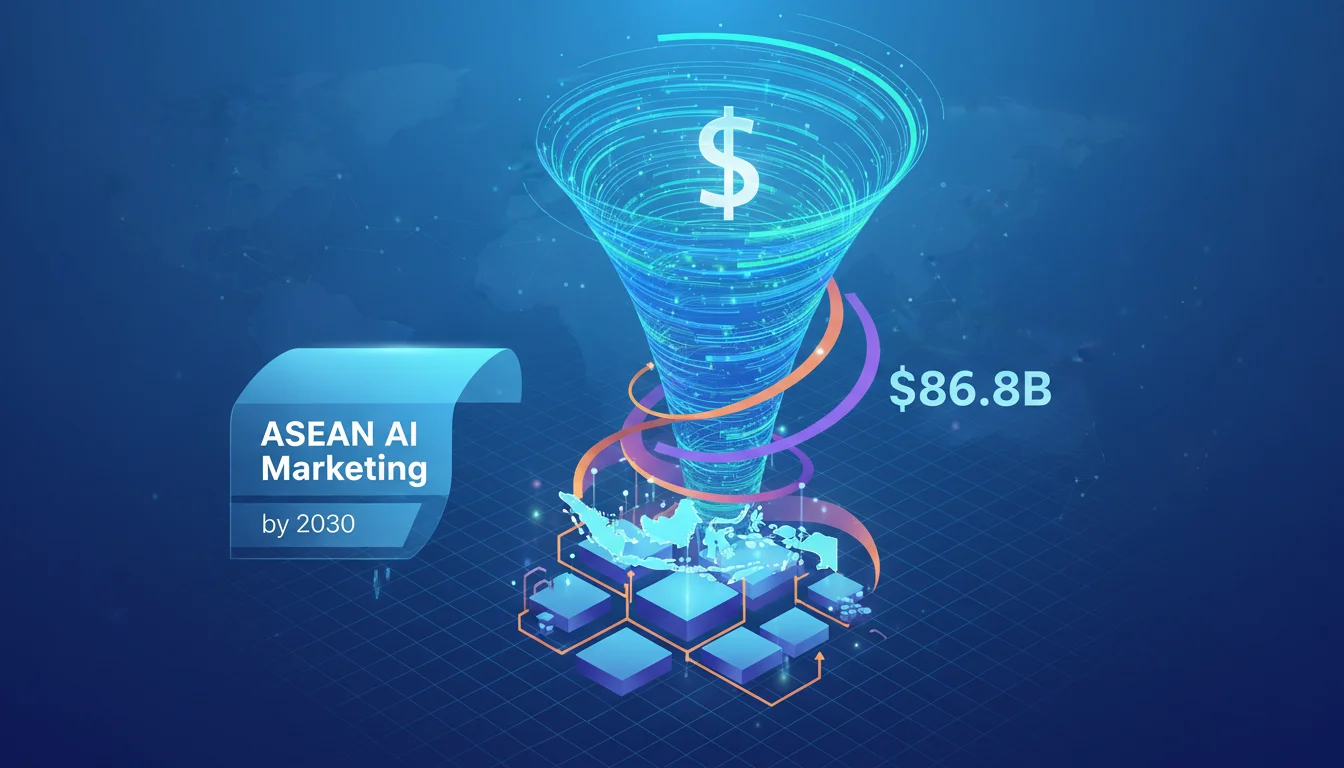
Southeast Asia’s AI market is on track to hit $86.8 billion by 2030, a number that should get every marketer’s attention. That kind of growth isn’t just a line on a chart. It’s a massive shift in global influence and forces a complete rethink of what effective marketing in the ASEAN region even looks like.
26% of Indonesian Businesses Have Already Adopted AI
A Google, Temasek, and Bain & Company study recently found that 26% of Indonesian businesses have already integrated AI into their operations, putting the country far ahead of its neighbors in Southeast Asia. This isn’t a big-corporation trend. Small and medium businesses (SMBs) are getting in on it too, using AI for everything from customer service bots to data analysis. For anyone in marketing, that 26% figure is a blinking red light: Indonesia is ready. It means AI-powered marketing tools for things like personalized ads and predicting consumer moves are going to land much harder there than in less-saturated markets. From my own work on regional campaigns, I can tell you a generic ASEAN AI strategy is a waste of money. Because Indonesia is so far ahead, its digital infrastructure is more mature and its people (both as workers and consumers) are more used to interacting with AI, so your campaigns there need to reflect that sophistication by clearly showing how AI makes the customer’s life better, maybe through smarter product recommendations or a support experience that doesn’t feel like talking to a wall.
Generative AI Tools See a 40% Increase in Usage for Content Creation Across ASEAN
Over just the past year, we’ve seen a 40% jump in the use of generative AI for content creation across the ASEAN region, which is completely changing the game for producing marketing materials. It’s happening fast. Companies are now using these tools to bang out first drafts of campaign copy, generate a mountain of social media images, and even create localized video scripts at a speed we couldn’t have imagined a couple of years ago. This puts pressure on marketers, especially if you’re working across a dozen different languages and cultures, to get good with these platforms, and I mean really good. We have to move past simple prompting and learn to properly fine-tune AI models so they can match a specific brand voice or capture the right cultural tone for, say, a campaign in Vietnam versus one for the Philippines. But the biggest mistake I see is thinking you can just automate everything and walk away. That AI-generated content still needs a human check to make sure it feels genuine, otherwise you risk sounding tone-deaf and alienating the very audience you’re trying to reach. The smart play is using AI to give your creative team superpowers, letting you produce a ton more relevant content without sacrificing quality.
55% of Consumers in Southeast Asia Are Willing to Share Data for Personalized Experiences
A NielsenIQ report says that 55% of consumers in Southeast Asia are willing to share personal data for a more personalized experience, but that number is incredibly misleading if you don’t read the fine print. That willingness is entirely conditional on trust. People aren’t just handing over data for fun. They expect to see a real benefit and they want to know exactly how their info is being used. So while that 55% figure points to a huge opportunity for AI-driven personalization, think customized product feeds on e-commerce platforms or tailored offers delivered via messaging apps, it’s also a warning about data privacy. Every country in ASEAN has its own data protection rules, like Singapore’s strict Personal Data Protection Act (PDPA), and you can’t afford to ignore them. I’ve seen firsthand that the brands who win are the ones who are upfront about their data policies and actually deliver relevant, useful content instead of just more spam. You have to treat it as a two-way street. If you just see it as data collection, you’ll break that trust, and that 55% willingness to share evaporates, turning your big opportunity into a legal mess.
Micro-Influencers in Southeast Asia Report 2.5x Higher Engagement Rates Than Macro-Influencers
The data from influencer marketing platforms is pretty clear: micro-influencers in Southeast Asia get, on average, 2.5 times higher engagement rates compared to macro-influencers. This completely upends the old ‘bigger is better’ thinking about reach. In a part of the world with so many distinct local communities, these smaller influencers have a real, authentic connection with their followers, making their recommendations feel more like advice from a friend than a paid ad. For brands, the smart move is to stop spending the whole budget on one or two big names and instead work with a whole network of micro-influencers who own a specific niche or geography. Imagine a beauty brand, instead of hiring a single national celebrity in Vietnam, partnering with a dozen local beauty fans in different provinces, each one speaking the local dialect and connecting with their own community. It’s also way more cost-effective, since their fees are lower, letting you spread your budget and your risk. The whole approach is more resilient because you’re not banking on one person, and it builds a much deeper brand presence in these fragmented markets. The real metric is the connection, not the follower count.
Only 30% of ASEAN Marketers Feel Fully Prepared for AI-Driven Marketing Campaigns
Despite all the growth and opportunity, an industry survey recently dropped a worrying number: only 30% of ASEAN marketers feel fully prepared for AI-driven marketing campaigns. That’s a huge skills gap. We see it everywhere, marketers who don’t quite get what AI can do, teams struggling to plug new tools into their old systems, and a lot of nervousness around data governance and ethics. So for a global brand coming into Southeast Asia, this is your double-edged sword: it’s tough to find local talent who already have these AI skills, but it’s also a massive opportunity to get ahead of the competition by being one of the first to really figure it out. The companies that will win here are the ones pouring money into training their marketing teams, creating a culture where it’s okay to experiment (and fail) with AI, and finding good tech partners. Simply buying the software gets you nowhere. Success depends entirely on the people using it. The common thinking that AI just automates things away is wrong. It actually requires marketers to be smarter and more strategic than ever. The people who get that and adapt right now are the ones who will be running the show in ASEAN marketing for the next ten years.
Southeast Asia’s AI-driven market is moving fast, creating a wide-open field for global brands to make their mark. The marketers who will come out on top are the ones who focus on localized AI strategies, get their teams trained on generative AI, earn customer trust with transparent data handling, and understand how to use micro-influencers effectively. Those are the keys to winning in this market.
What specific AI tools are most relevant for ASEAN marketing in 2026?
For 2026, you’ll want to get very familiar with the AI in Google Performance Max and Meta’s Advantage+ Creative. Beyond ads, you need AI inside your CRM to map out personalized journeys and a good generative AI tool that can handle multiple languages for content. Don’t forget predictive analytics tools, either. They’re becoming essential for spotting market trends before your competitors do.
How do data privacy regulations vary across Southeast Asia for AI marketing?
They’re all over the place. Singapore has its Personal Data Protection Act (PDPA), but then Thailand, Indonesia, and others have their own unique laws. There’s no shortcut. You have to do your homework for every single country you target, making sure you’re compliant with their specific rules on user consent, where you can store data, and how you have to report a breach.
What is the best approach for integrating AI into existing marketing workflows?
Don’t try to do everything at once. Pick a couple of high-impact spots to start, like automating your ad bidding or personalizing email sequences. Add one tool at a time and make sure it talks to your existing systems without breaking things. The most important part is training your team on how to use the new software and setting up clear KPIs so you can actually measure if the AI is helping you hit your goals.
Why are micro-influencers more effective in Southeast Asia than macro-influencers?
Because they feel more real. A micro-influencer usually has a smaller, more dedicated group of followers who trust their opinion. So when they recommend something, it feels like advice from a friend, not a giant, impersonal ad from a celebrity. This authenticity leads to better engagement and actual sales, especially within tight-knit local communities.
What is the impact of AI on customer engagement strategies in ASEAN?
It lets you personalize everything at a scale that was impossible before. You can offer 24/7 support with good chatbots, anticipate what a customer might need next, and send them actually relevant messages. When you’re constantly providing timely, helpful interactions on every channel, you build a much stronger relationship with your customers and keep them happier.


