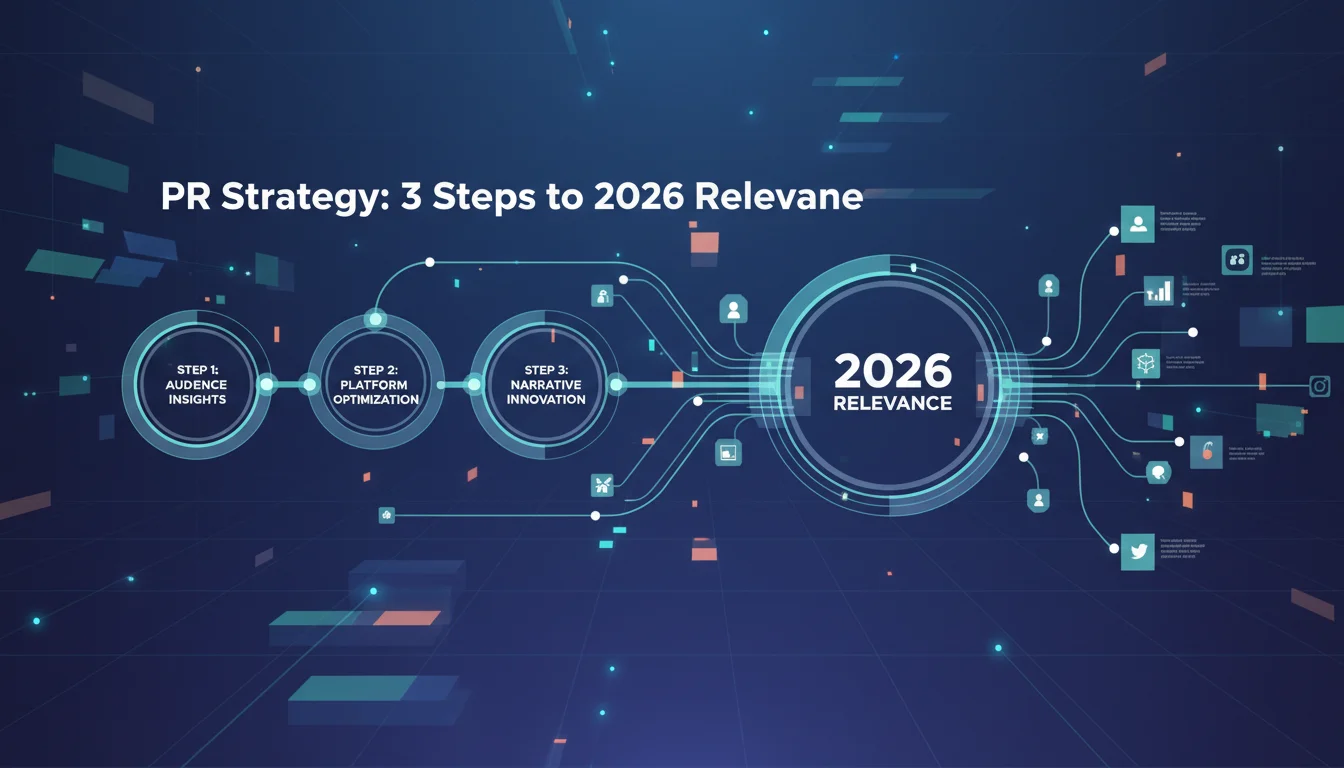
 By Editorial Team
In 2026, if you’re only doing reactive PR, you’re setting yourself up for irrelevance. You have to get proactive with strategies built on solid future forecasts to keep a brand visible and actually shape a narrative. When you can anticipate the next big trend, tech shift, or social conversation, you can position your clients as thought leaders. The real question is how to turn those abstract predictions into PR campaigns that actually work.
Key Takeaways
- Get a quarterly trend analysis going with tools like Gartner Hype Cycle reports and Pew Research Center data. You’re looking for emerging topics you can get ahead of with at least a 12-month lead time.
- Build a separate “future events” content calendar to map out news hooks and thought leadership plays 6 to 18 months from now.
- Think through three specific crisis scenarios based on risks you’ve identified in your forecasts, complete with messaging for each, so you’re not caught flat-footed.
- Set aside 15% of your quarterly PR budget for pure experimental campaigns. Tie them to early-stage trends you’re seeing and use them to test out new narratives.
1. Establish a Strong Trend Monitoring Framework
First thing’s first: you need a system for gathering and analyzing predictive data. This is about intelligence, not guesswork. I start by setting up a monitoring system that pulls from a bunch of different places. For tech, I lean hard on reports like the Gartner Hype Cycle. I look for tech moving from the “Innovation Trigger” to the “Peak of Inflated Expectations” for fresh PR opportunities, and for stuff entering the “Slope of Enlightenment” when it’s time for more practical, case-study-driven stories. For social and demographic shifts, you can’t beat the Pew Research Center, whose long-term studies give you a real window into how public attitudes are changing. For example, their recent 2025 report showing Gen Z’s rising political engagement was an immediate sign for my CPG clients to get their CSR messaging tightened up.
My daily workflow is built around alerts in tools like Google Alerts and Meltwater. I’ve got them set for keywords on new tech (“AI ethics,” “quantum computing applications,” “sustainable urban farming”), policy moves (“new data privacy regulations,” “carbon credit markets”), and consumer behavior (“subscription fatigue,” “experience economy 2.0”). These come in as daily digests, and I make it a point to scan the top 10-15 articles every morning, which is how you build a real, layered picture of what’s coming over the horizon.
Pro Tip: Don’t just read the headlines. Actually look at the methodology section of the reports you’re pulling from. If you can understand how they came up with the forecast, what data they used, and what they admit are the limitations, you can judge for yourself how reliable it is for your client’s specific industry. A forecast based on a 10,000-person global survey has a lot more weight than some prediction from a niche blog.
2. Map Forecasts to Client Objectives and Expertise
Once you have a pile of potential future events, you have to filter them. The next step is running them through the lens of your client’s actual goals, their industry, and what they’re already good at. You have to focus on relevant trends because chasing everything just dilutes your impact. I use a simple matrix. On one axis, I’ll list the future trends I’ve flagged (e.g., AR adoption in retail, more scrutiny on supply chain transparency, rise of personalized preventative healthcare). On the other axis, I put the client’s objectives (e.g., increase brand awareness by 15%, position CEO as a thought leader in X, drive 10% more qualified leads). Then it’s just a matter of seeing where they overlap.
So, if a forecast points to a huge spike in demand for sustainable packaging by 2027, and my client is a manufacturer trying to boost their ESG profile, that’s a bingo. We can immediately start planning content around their current R&D in new materials or get their execs ready to comment on new packaging laws. But if that same client is in traditional finance and a forecast is all about a boom in DAOs, the connection is probably too weak to pursue unless they happen to have a fintech division messing with blockchain. You’re looking for that sweet spot where the future meets what the client can actually do right now.
Common Mistake: Forgetting to talk to internal teams early on. PR requires collaboration. Before you go all-in on a campaign based on some forecast, you have to check in with product, R&D, sales, and legal. They’ll tell you what’s actually possible, what’s already being worked on, and what landmines to avoid. I’ve seen great PR ideas completely fail because they didn’t have the internal support or resources to back them up.
3. Develop a Future-Focused Content Calendar
With relevant forecasts identified and mapped to goals, you can build a content calendar that goes way beyond the next quarter. This has to be a living document that looks 6 to 18 months out. I use a separate “Future Events” tab in our main content calendar (we use tools like Airtable or Monday.com). For every entry, I log the forecasted event, its projected date, potential news hooks, target media, the right spokesperson, and the content format, is it a white paper, an op-ed, a webinar?
For example, a forecast might suggest that standalone 5G networks will finally enable widespread industrial IoT by Q3 2026. So in Q2, we’d plan an op-ed from the client’s CTO for a major tech trade, talking about what that means for manufacturing. Then in Q3, we’d follow up with a joint webinar with a partner to show it in action. You’re creating a series of touchpoints that build authority over time instead of just a one-off press release. This long-term planning gives you the space for better research, deeper thought leadership, and in the end, bigger media wins.
I also bake “trigger points” into this calendar. These are specific events that would force us to act immediately or pivot our plan. If a new government regulation on AI governance gets fast-tracked out of nowhere, that’s a trigger. It means we accelerate our planned content on AI ethics and get our client out there commenting on the new policy right away.
4. Craft Proactive Narrative Arcs
You have to shape the conversation around future events, not just react to them. This means building proactive narrative arcs. Instead of just launching a product that solves a future problem, you position your client as the one who saw that problem coming a mile away. You have to build a long-form story where each piece of content is a new chapter.
Let’s say a forecast shows growing consumer frustration with one-size-fits-all wellness advice. A health tech client shouldn’t just drop a new app. A better narrative arc starts months earlier with an opinion piece from the CEO on the limits of generic health plans. That’s followed by a data report the company commissions on the economic cost of chronic disease, then maybe some behind-the-scenes interviews with their R&D team on their biometric data research, all of it leading up to the launch of their personalized platform. Every piece reinforces the client’s foresight.
I use a “before, during, and after” framework for every big forecast. It’s very effective. Before the trend hits the mainstream, we’re out there defining the problem and establishing our client’s expertise. During the peak of the conversation, we’re offering their solution and commentary. And After, we’re publishing reflections on the impact and pointing to what’s next. This gives the whole campaign a consistent, persuasive narrative.
Pro Tip: Don’t be afraid to take a contrarian view, as long as it’s well-supported. If every pundit is predicting X will happen, but your client has a data-backed argument for Y, that’s a story that can get a ton of media attention. Just make sure the counter-narrative has real data or unique insights behind it, not just opinion.
5. Build Relationships with Forward-Looking Media
Some journalists are more interested in the future than others. To get traction with these forecast-driven stories, you have to find and build relationships with the reporters and editors who are paid to think about long-term shifts. These are the folks known for their investigative depth and thought leadership pieces.
I keep a specific media list just for “future-focused” contacts. It includes reporters at The Wall Street Journal’s “Future of Everything” section, writers at MIT Technology Review, and certain columnists at business journals who write about innovation. When I pitch them, I customize it completely, usually referencing their past work. Instead of a generic release, I might offer an exclusive chat with our client’s CEO about their take on a trend, or give them early access to a new research report we did that challenges a popular prediction. This approach builds trust and makes your client a go-to source for their next big story.
A personalized email that says, “I saw your article last month on the future of work and it made me think of my client’s new white paper on AI’s role in workforce transformation by 2030…” is going to work a thousand times better than a mass email blast. Journalists are looking for unique insights, which is exactly what a good forecast gives you.
6. Measure and Adapt
Like any other PR strategy, this requires constant measurement and adjustment. The future is uncertain and even the best forecasts can be wrong. I track KPIs that go beyond just media mentions. I’m looking at share of voice on emerging topics (using a tool like Brandwatch to see who is owning the conversation around a forecasted trend), the sentiment around our proactive messaging, and in the end, how often our spokespeople get quoted as experts on these future topics. We also watch for traffic spikes to our thought leadership content and track leads from any gated reports or webinars.
We do a full review every quarter. Which forecasts were right? Which were wrong, and why? This feedback loop is what helps us refine our monitoring, get better at predicting, and adjust our content strategy on the fly. Sometimes a trend accelerates, and we have to push our whole calendar up. Other times it fizzles out, and we need to be smart enough to kill the campaign and put those resources somewhere better. You should aim for agility in response to evolving predictions, not perfect prediction itself. The value is in being the first, or the most insightful, person to talk about what’s coming.
Using future forecasts changes PR from a reactive support function into a strategic engine for growth. By systematically monitoring trends, tying them to client goals, building long-term content plans, telling good stories, targeting the right media, and constantly adapting, you can make your clients essential voices in the conversations of tomorrow.
What’s the typical lead time for an effective future-focused PR campaign?
For a campaign that really makes an impact, a lead time of 6 to 18 months is what you want. That’s enough time to do real research, develop heavy-hitting content like white papers or proprietary studies, and build relationships with the right journalists who cover long-term trends. With less time you can maybe jump on some breaking news, but longer planning is what lets you actually shape the narrative.
How can I convince clients to invest in long-term, forecast-driven PR?
You have to show them tangible benefits with concrete examples. Point to competitors who got in early on a trend and won significant market share or became the go-to thought leader. I’d bring data showing the long-term impact and shelf life of evergreen content that came from a forecast versus a quick-hit reactive campaign. You have to frame it as an investment in their future relevance and a way to manage risk.
What are the biggest risks of building PR around future forecasts?
The main risk is that the forecast is just wrong. If that happens, you’ve wasted resources and your client can lose credibility for hyping a trend that never happened. You can mitigate this by diversifying where you get your forecasts, making sure you can validate a trend with several data points, building a ton of flexibility into your plans, and being ready to pivot the second the ground starts to shift.
Can a small business actually use future forecasts for PR?
Yes, and they can be more agile than big companies in responding to trends. A small business might not have the budget for a huge proprietary research project, but they can absolutely use public reports from places like eMarketer or their own industry associations. By focusing on very specific, niche forecasts that matter to their market, they can really punch above their weight and establish authority before anyone else.
How often should I be updating my future events content calendar?
A full review and update of the calendar each quarter is a good rhythm. But the monitoring has to be constant, I’d say at least a weekly check-in, so you can make small adjustments as things happen. Of course, if there’s a huge shift in a forecast or the client’s goals change, you might need to do a complete overhaul right then and there.


