 By Editorial Team
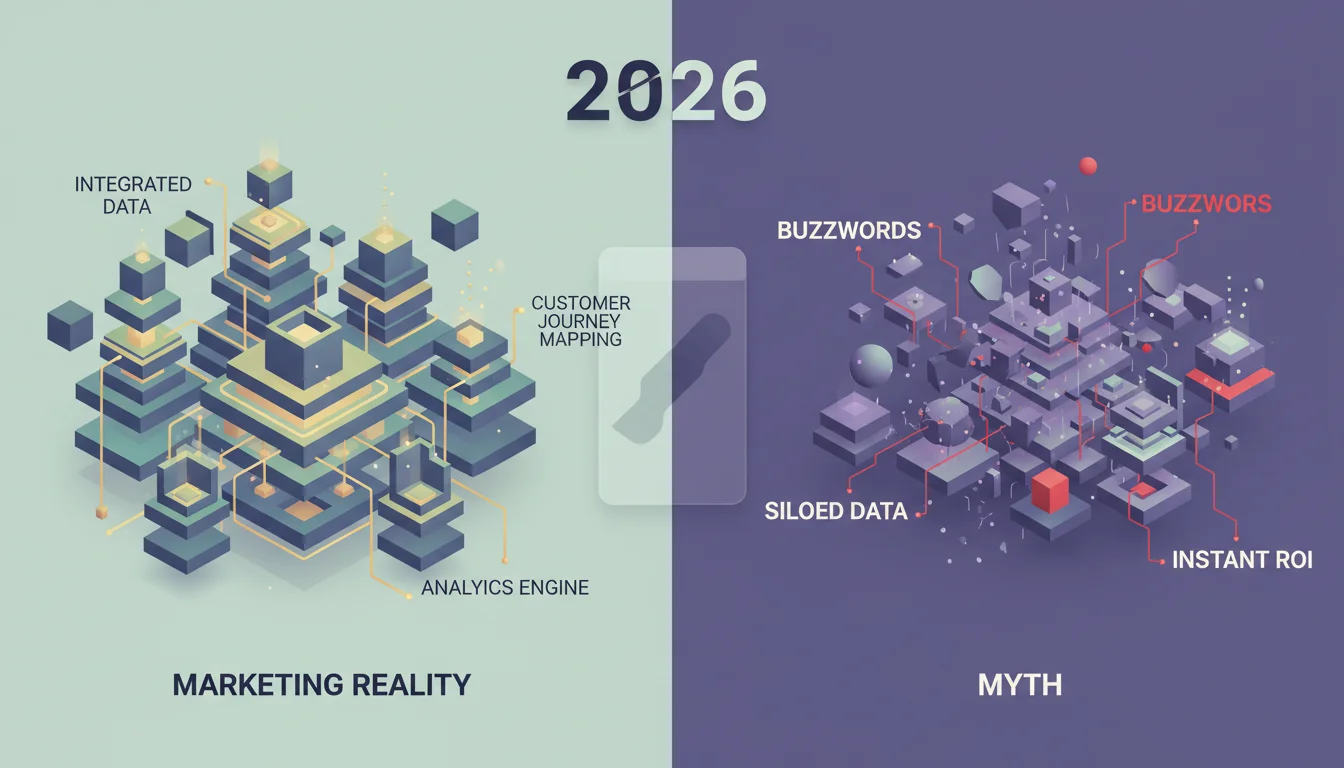
The talk around executive AI adoption is full of garbage, and it’s creating a huge gap between what marketing leaders think is possible and what’s actually happening. A lot of executives are working off old ideas about what AI can do, how you plug it in, and what it really means for marketing strategy.
Key Takeaways
- Real AI integration starts with fixing your messy data infrastructure, followed by deploying tools.
- Winning with AI means getting different departments to work together and clearly defining the business problem you’re trying to solve.
- Marketers need new skills, fast: prompt engineering, data analysis, and managing AI-driven projects.
- The real power of marketing AI is its ability to do advanced predictive analytics and hyper-personalization, way beyond basic automation.
- To measure AI’s ROI, you have to track specific KPIs that are directly connected to the campaigns and operations it touches.
Myth 1: AI is a Plug-and-Play Solution for Instant Marketing Gains
Too many marketing execs think buying an AI tool is like flipping a switch for higher ROAS. That’s a fantasy. It fundamentally misunderstands that this technology is completely dependent on your data and your people. Getting AI to work is an iterative process that requires a ton of prep work. AI tools don’t show up knowing your business. For example, if you get a new AI content platform, you have to spend ages feeding it your brand guidelines, tone of voice docs, and performance data from old campaigns, otherwise it just spits out generic garbage. The same goes for your CRM. Before an AI can predict which customer is about to leave or what email to send them, the data in that CRM has to be clean and organized. That often means months of data cleanup, deduplicating contacts, and forcing your sales and marketing teams to use the same input rules. A 2025 eMarketer report found that only 38% of companies felt their data infrastructure was “AI-ready” when they started, which shows just how much of this foundational work gets ignored. The belief that you can just “turn on” AI and watch the magic happen leads to nothing but disappointment and burned cash.
Myth 2: AI Will Replace All Human Marketing Roles
The constant fear that AI will make marketers obsolete is causing a lot of unnecessary anxiety. Yes, AI is automating repetitive, data-heavy tasks, but it’s augmenting human roles instead of eliminating them entirely. AI-powered programmatic ad platforms can optimize bids way faster than a human media buyer, and analytics engines can find patterns in terabytes of customer data in minutes. That’s a given. But the creative, strategic, and human parts of marketing aren’t going anywhere. An AI can write a thousand versions of ad copy, but it can’t come up with the big, emotional brand campaign idea. It can analyze social media sentiment, but can it build a real relationship with an influencer or manage a delicate PR crisis? (No, it can’t.) The job is evolving. Marketers are becoming the conductors of the AI orchestra, focusing on writing good prompts, interpreting the data the AI spits out, and applying their own judgment to the big decisions. A content marketer will use AI for a first draft, but they’re still the one who has to shape the story, inject the brand’s personality, and check the facts. Your skillset has to change, prioritizing strategic thinking over manual work. A 2026 IAB report confirms this, noting a 45% spike in demand for people with “AI literacy” on top of their regular marketing skills.
Myth 3: AI is Only for Large Enterprises with Massive Budgets
There’s this lingering idea that you need a Fortune 500 bank account and a team of data scientists to do anything with AI. That might have been true five years ago, but the tech has become much more accessible. Today, there’s a whole range of affordable, scalable AI tools for almost any business, from a tiny agency to a mid-sized brand. The explosion of cloud-based AI services and APIs has torn down the old barriers. Many marketing automation platforms you’re already using probably have AI features like email subject line optimizers or predictive lead scoring baked right into their standard plans. Think of a small e-commerce shop using a cheap AI chatbot for basic customer questions, which frees up the one support person to handle the hard problems. Or a local company using the AI inside Google Ads to find better audiences, getting a level of precision that used to cost a fortune. These aren’t million-dollar projects. Many of these tools are monthly subscriptions that grow with you. You have to start small, find a specific problem AI can solve (like social media scheduling or personalizing your website), and build from there. The notion that you need a huge budget to even get started in AI marketing is completely out of date.
Myth 4: AI is a “Set It and Forget It” Marketing Tool
Some execs see AI as a robot you can build, turn on, and walk away from while it runs your marketing forever. This hands-off approach is a recipe for failure. AI systems need constant watching, tuning, and human guidance, especially in a fast-moving field like marketing. Markets change, customers change, and competitors do new things. Your AI models have to be updated to keep up. Take an AI-driven bidding strategy on Google Ads. The AI can adjust bids every second, but a human still has to set the campaign goals, define the budget, check the performance, and approve the ad creative. If your company launches a new product, or a competitor starts a huge sale, a person has to step in and retrain or adjust the AI model to account for that new information. If you don’t, the AI can “drift,” chasing old goals or getting confused by new market signals, like an AI optimizing for clicks that ends up driving a ton of useless traffic because a human didn’t set a clear conversion goal. Thinking you can “set it and forget it” ignores the reality that you need to be a partner with the AI, interpreting its outputs and making sure it’s still aligned with what the business is trying to do.
Myth 5: AI Only Impacts Digital Channels
The AI conversation in marketing always seems to land on social media, email, and digital ads. While its effect there is huge, focusing only on digital means you’re missing a ton of other opportunities to use AI in traditional marketing and even your core business strategy. AI can make offline experiences better, optimize how a physical store runs, and even help figure out what products to build next. For example, retailers are using AI to analyze foot traffic patterns to redesign store layouts, and they’re using mobile apps to send personalized offers to people while they’re physically in the store. These aren’t digital-only plays. In product development, AI can chew through mountains of customer reviews and social media comments to find gaps in the market, pointing your team toward new products that are easier to sell from day one. A CPG company could use AI to find out customers are suddenly obsessed with a certain ingredient, leading them to create a whole new product line. Even in old-school media buying, algorithms are being used to predict the best time to run a TV or radio ad. The idea that AI lives only online is a narrow view that causes marketers to miss out on integrating it across every single customer touchpoint. The path to successful executive AI adoption in marketing requires a realistic understanding of what it can and can’t do. Marketing leaders have to get their data house in order, build new skills on their teams, and treat AI like a strategic partner.
What is the most critical first step for executives considering AI in marketing?
The most critical first step is to take a hard look at your data. Seriously. AI models are completely useless if you feed them messy, inconsistent, or incomplete information, so cleaning up your data is the absolute foundation before you even think about buying a tool.
How can marketing teams prepare for the shift towards AI-augmented roles?
Your team needs to learn how to talk to AI (prompt engineering is a real skill), how to interpret the data it gives back, and how to use their own brain to check the AI’s work. It’s also smart to run training workshops on the specific AI tools that are popular in your industry.
What are common pitfalls to avoid when implementing AI in marketing?
The biggest mistakes are expecting instant results without doing the prep work, not having a clear business problem for the AI to solve, and just letting the models run without any human oversight. You have to actively manage AI. It’s a powerful tool that requires your team’s creativity and strategic input.
How can a small or medium-sized business (SMB) use AI in marketing without a large budget?
You can start by using the AI features that are probably already in the software you own, like your email marketing service or CRM. From there, you can find plenty of affordable, cloud-based AI tools that do one thing well, like content generation or running a chatbot, without a massive upfront cost.
How should marketing leaders measure the ROI of AI initiatives?
You measure the ROI of AI with specific, hard numbers tied directly to what the AI is doing. You need to know your baseline numbers before you start, for example, your lead conversion rate or average customer service response time. After you implement AI, you check if those numbers have improved. It’s that straightforward.


