 By Editorial Team
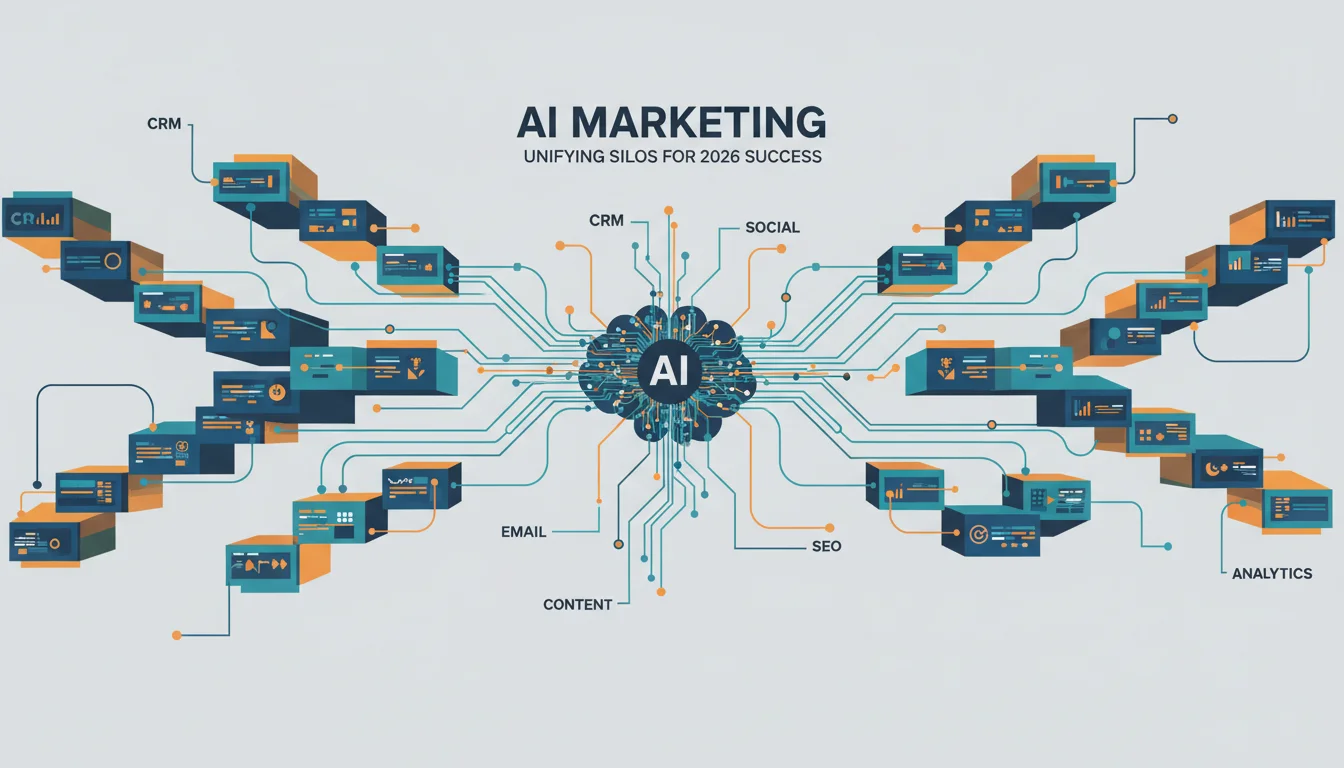
It’s a huge problem: a late 2025 survey found that 72% of marketing leaders are running fragmented AI initiatives spread across their departments. This creates massive inefficiencies. Despite the hype around advanced analytics, this siloed reality actively gets in the way of creating a unified customer experience and figuring out what’s actually working. Everyone wants AI marketing centralization, but that goal keeps running into the hard reality of messy data and conflicting department goals. So, is real integration even possible?
Key Takeaways
- You’ve got to consolidate your AI tools and data sources into a single platform to get a unified customer view, which can cut data duplication by up to 40%.
- A centralized AI governance framework is non-negotiable. 65% of the marketing teams who get AI right establish clear data ownership and access rules from day one.
- Training your cross-functional teams on the same shared AI platform typically boosts campaign effectiveness by an average of 15% because collaboration improves and the messaging stays consistent.
- Make integrating with your core CRM and CDP systems the top priority. 55% of marketers say a lack of integration is the main thing stopping them from making AI marketing work.
“86.4% of marketing teams now use AI somewhere in their workflows. Yet, measuring ROI still tops the challenge list at 33%, according to HubSpot’s 2026 State of Marketing Report.”
45% of AI Marketing Projects Fail Due to Data Silos
I’ve been consulting with enterprise marketing teams for the last three years, and the most common thing that kills AI projects isn’t the tech. It’s the org chart. A Q4 2025 IAB report confirms it, showing that almost half of all AI marketing projects flop or seriously underperform simply because the data is locked up in different departments. Just think about your own teams: social is using one AI for content, email has a different one for personalization, and paid media is on yet another for bid optimization. Each tool is spitting out its own data, often in proprietary formats nobody else can read. When those systems can’t talk, you completely lose a well-rounded view of the customer journey, making it impossible to accurately attribute a conversion, understand cross-channel effects, or build a complete customer profile. The real issue is that you’re forced to make big-budget decisions with an incomplete picture, which just leads to wasted ad spend and blown opportunities.
Only 18% of Companies Have a Unified AI Marketing Strategy
That stat, from a Q1 2026 eMarketer analysis, points directly to a failure in leadership. Most companies are treating AI as a shopping list of point solutions, not as a core strategic capability. I see it all the time, a marketing director signs off on a cool new AI tool to fix one specific problem without any thought for a larger architectural plan. This gives you a patchwork of systems that might provide a quick win but creates a massive integration nightmare down the road. A real strategy means building a central AI platform or data layer where all your marketing data lives, and all your models can access it, which requires defining common KPIs and standardizing how you bring data in. Without that foresight, your departmental wins will never add up to a high-performing marketing engine. It’s like building a house one room at a time with different contractors who all have their own blueprints and just hoping the plumbing and electrical connect on their own.
Companies with Centralized AI See a 15% Increase in Campaign ROI
That finding, from a HubSpot research brief in early 2026, lines up perfectly with what I’ve seen work in the field. When all your marketing data, from website clicks and email opens to ad impressions and CRM notes, is flowing into a single AI platform, the insights you get are way more powerful. Imagine an AI model that can simultaneously analyze a customer’s recent browsing, their email engagement, their purchase history, and their social ad interactions. That complete picture lets you deliver hyper-personalized messages at every touchpoint and optimize your budget with insane precision. Your models can even start predicting churn risk or spotting an upsell opportunity before a human could. Honestly, the 15% ROI increase feels conservative. I’ve had clients blow past that number just by cutting out redundant ad spend and boosting conversions with truly integrated campaigns. It’s the difference between guessing what a customer wants and knowing what they need right when they need it.
The Conventional Wisdom is Wrong: Centralization Isn’t Just About Cost Savings
When leaders first consider centralizing their marketing AI, their minds immediately go to cost savings from automation and getting rid of redundant tools. Sure, those benefits are real, but they’re a small part of the story. The popular thinking is that centralization is about “doing more with less.” I think that’s the wrong frame entirely. The main reason to centralize your AI should be to deliver a far better customer experience and gain deeper market intelligence that your competitors can’t see. Cost savings are a nice bonus, not the main goal. If you focus only on cost, you’ll inevitably cut corners on data quality or tool capabilities, which defeats the whole purpose of using AI. The real power is in creating a smooth, personal journey for every customer that builds loyalty and long-term value. This strategic advantage, the ability to build stronger customer relationships, is worth so much more than any short-term cost-cutting.
Only 30% of Marketing Teams Have Dedicated AI Governance Policies
That low number from a Q3 2025 Nielsen survey is the scariest one here. Without clear governance, even the best centralized AI system will turn to chaos. Suddenly no one’s sure who owns the data. What are the ethical rules for how we use these models? How do we stay compliant with privacy laws like GDPR or CCPA across all our different AI apps? What’s the protocol when a model starts showing bias? These aren’t just details. I’ve watched the fallout when these questions get ignored: you get biased ad targeting that leads to a PR disaster, data breaches from fuzzy access controls, and a completely inconsistent brand voice because different AI models are all operating on different assumptions. A strong AI governance framework, with a cross-functional ethics committee and clear data stewards, is foundational for any sustainable success in AI marketing.
Centralizing AI marketing requires a fundamental change in how marketing teams operate and think about their data. It’s a technological upgrade, yes, but it’s more about the operational shift. By consolidating your tools, data, and strategies, you can finally move past fragmented efforts and build a unified, intelligent marketing engine that actually serves your customers.
What are the biggest challenges in centralizing AI marketing?
The biggest hurdles are almost always organizational, not technical. You have to overcome existing data silos, stitch together different technologies, and get executive buy-in for a long-term plan instead of just quick fixes. On top of that, you need to establish solid data governance and ethical AI policies. Resistance to change from your own teams and just finding people with the right skills are also huge challenges.
How can organizations start centralizing their AI marketing efforts?
Start with a complete audit of every AI tool and data source you’re currently using across all marketing functions. Figure out what data points you have in common and decide on a universal customer ID to tie everything together. From there, prioritize integrating your core systems, making your CRM and Customer Data Platform (CDP) the central hub. Then you can build out a clear AI strategy with defined goals and a phased roadmap, starting with one or two high-impact projects first to get a win.
What role does a Customer Data Platform (CDP) play in AI marketing centralization?
A CDP is the backbone of this whole effort. It’s the thing that pulls all your customer data from every source, your website, your app, your support desk, into one single, persistent profile for each person. This unified profile is the clean, integrated data foundation your AI models need to work properly. Without a good CDP, your AI will be working with fragmented, inconsistent data, and you’ll get garbage insights.
How do you measure the success of AI marketing centralization?
You can measure it with a few key metrics: look for an increase in campaign ROI, better customer lifetime value (CLTV), higher conversion rates, and a lower customer acquisition cost (CAC). Don’t forget to track customer satisfaction scores, too. Internally, you’ll know it’s working when you see less data duplication, your teams can launch campaigns faster, and people are actually collaborating across departments.
Is it better to build or buy AI marketing solutions for a centralized approach?
The build-versus-buy decision really depends on your in-house talent, budget, and what you need to do. Buying an off-the-shelf tool gets you up and running faster and gives you access to vendor support, which is great for standard things like ad optimization. But building a custom solution gives you more flexibility and a unique competitive edge. For most companies, a hybrid approach works best, you integrate specialized third-party tools into a custom data infrastructure you control.


