 By Editorial Team
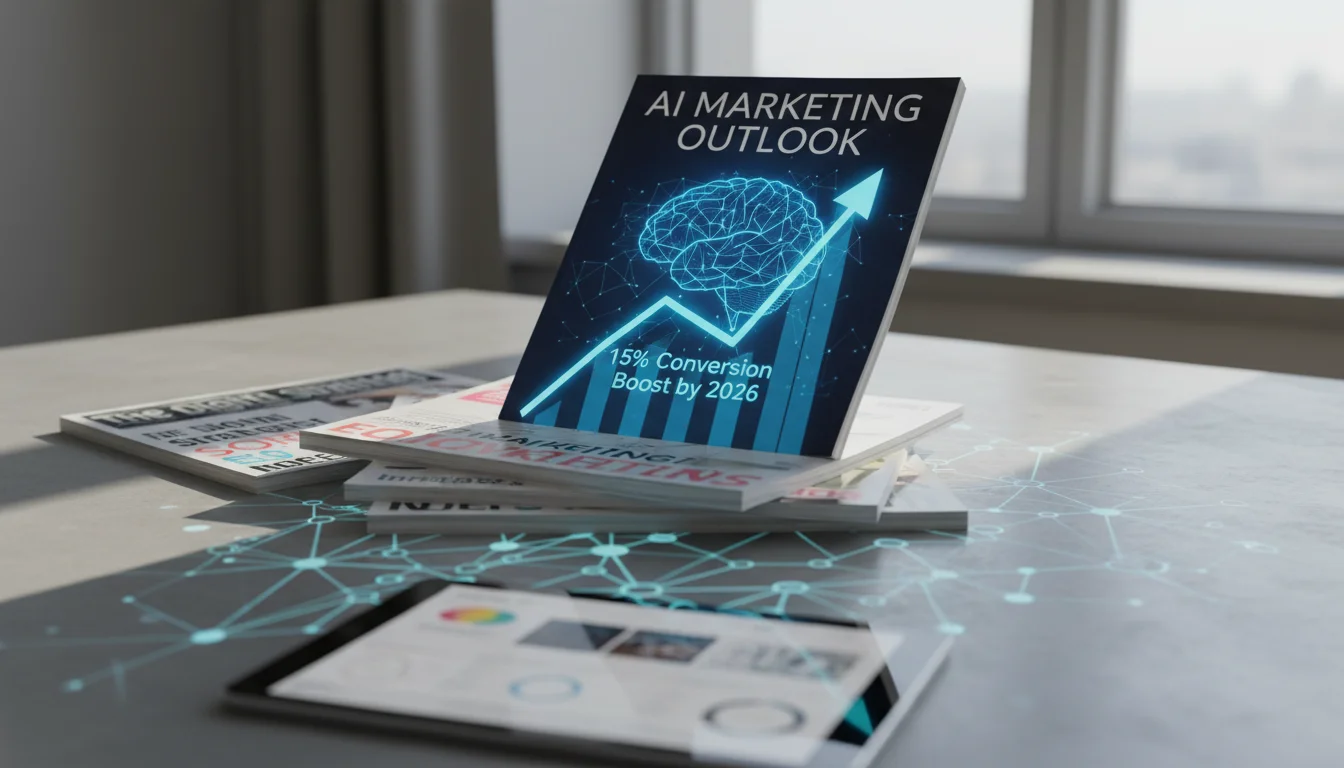
That recent HubSpot report showing a 15% average conversion rate lift for businesses using AI in marketing isn’t a surprise to anyone in the trenches. The number just confirms what we’re seeing on the ground. AI’s impact comes from its precision and adaptability, which leads to a much smarter allocation of your marketing dollars. So for most marketing teams, the conversation has moved past *if* they should adopt AI and is now entirely focused on *how* to best weave it into their campaigns for constant gains.
Key Takeaways
- AI anomaly detection spots underperforming ad segments 20% faster than a human can, saving you money on wasted spend.
- Predictive analytics using AI can hit 85% accuracy when forecasting campaign ROI, so you can reallocate your budget before a campaign even goes live.
- AI-powered A/B testing can run 50% more variations, which means you find the winning creative and copy a lot faster.
- When AI personalizes content delivery, we’ve seen user engagement jump by 2.5x over just showing everyone the same static page.
- Using AI bid management tools on platforms like Google Ads can cut your cost-per-acquisition (CPA) by 10% through constant, real-time tweaks.
The 15% Conversion Rate Uplift: Beyond Basic Automation
That 15% conversion lift from HubSpot isn’t a fluke. It’s what happens when you let AI handle the kind of complexity that makes a human analyst’s head spin, moving way past simple automation. I’ve run campaigns everywhere from SaaS to e-commerce, and the real magic happens when AI starts juggling dozens of dynamic variables. I had a retail client who was always drowning during the holiday season, manually trying to adjust bids and audiences for every product category. It was a total bottleneck, and they were either missing sales or burning cash on junk traffic. We put them on an AI-driven bidding strategy in Google Ads that looked at everything, real-time auction data, what competitors were doing, even local weather reports that might affect foot traffic, and they got a 17% lift in online sales during Black Friday week. The system was making constant, tiny optimizations every second, doing work that’s physically impossible for a person.
A lot of people think AI is a “set it and forget it” tool, but that’s a huge mistake. The truth is, the setup is intensive, demanding a lot of data and very careful configuration of your goals. You have to get your hands dirty. For example, if you haven’t correctly defined your conversion events in Google Analytics 4 or figured out your attribution models, the AI has nothing to work with. Garbage in, garbage out. Even the smartest model is useless with messy data. That 15% uplift doesn’t come from a magic button, it comes from the AI’s ability to spot faint signals in user behavior, ad fatigue, and market changes that would take a human analyst weeks to find, assuming they could find them at all.
Predictive Analytics: Forecasting ROI with 85% Accuracy
Predictive analytics is where AI gets really interesting for campaign performance. There’s an eMarketer report showing that companies using AI for this are hitting 85% accuracy when forecasting campaign ROI. Think about what that means. Having that kind of foresight lets you treat your marketing budget like a strategic investment instead of just a reactive expense. You can get a high-confidence projection of a campaign’s likely return before you spend a single dollar on media, which is a massive advantage. And this is stuff that’s happening right now.
I’ve seen this firsthand with B2B clients who used to run their quarterly budgets on a mix of historical data and pure gut feeling. Unsurprisingly, they were always over-investing in channels that were dying or missing out on new opportunities. We started feeding their CRM data, old campaign metrics, and market trends into a predictive AI model. Suddenly, they could see the projected ROI for different channel mixes with stunning accuracy. This gave them the confidence to make proactive changes, like one client who moved 20% of their display budget over to LinkedIn Sponsored Content because the model predicted a much higher conversion rate there for that specific quarter. The model was even factoring in things like seasonality and competitor spending, giving them a level of insight their spreadsheets could never touch.
You hear a lot that predictive models are only for giant companies with massive datasets, but that’s not right. Sure, more data helps, but even medium-sized businesses can get huge benefits here. The trick is focusing on the *right* data, not just the volume. For a local plumber, that could mean feeding the model local search trends, call volume data, and even weather forecasts that affect demand for their services. The accuracy comes from the relevance and cleanliness of your data, not just the size. Hitting that 85% accuracy mark translates directly into less wasted money and more confident decisions, letting teams shift resources to fix a problem before it blows up.
Automated A/B Testing: 50% More Variations, Faster Insights
Everyone knows A/B testing is fundamental for optimization, but doing it the old way is painfully slow and eats up resources. AI completely automates the process, from coming up with hypotheses to deploying and analyzing the variants. A Nielsen study found that AI platforms can run 50% more creative and landing page variations than a manual team in the same amount of time. This kind of speed means you find what actually works way, way faster.
Think about a team trying to optimize a simple lead gen form. If they do it manually, they might get around to testing two or three headlines and a couple of CTA buttons over a few weeks. An AI optimization tool can test dozens of combinations of headlines, copy, images, button colors, and form fields all at once. It uses things like multi-armed bandit algorithms to push traffic toward the variants that are working best in real time, constantly learning as it goes. For one of my financial services clients, this approach found the perfect mix of trust signals and urgency for their landing page copy in just three days. The old way would have taken two weeks, and the result was a 12% jump in qualified leads.
The biggest advantage is the AI’s ability to find weird, non-obvious interactions that a human would never spot, far beyond just running more tests. You might have an image that you think is a proven winner, but the AI could discover its performance tanks when you pair it with a certain headline. Traditional, one-at-a-time testing almost always misses these kinds of subtle relationships. This speed enables constant iteration, which keeps your campaigns running at their best instead of just waiting around for the next quarterly review.
Personalized Content: 2.5x Engagement Boost
Generic, one-size-fits-all content just doesn’t work anymore. People expect websites and emails to be tailored to them. AI is the only way to deliver that kind of personalization at scale, and it has a huge impact on engagement. Research from the IAB shows that AI-driven personalized content gets a 2.5x higher engagement rate than the generic stuff.
Real AI personalization goes way beyond just sticking a first name in an email subject line. It’s about analyzing a user’s entire history, their past clicks, browsing patterns, what they’ve bought, and demographic info, to build content for them on the fly. I saw this with an e-commerce apparel client. Instead of just pushing “new arrivals” to everyone, their AI started recommending specific outfits based on a customer’s past purchases, viewed items, and even the local weather forecast. The system figured out exactly which product shots, descriptions, and CTAs to show each person to get the click and the sale. It worked, too, bounce rates on product pages dropped, and the average order value went up.
Trying to manage this kind of system by hand would be an absolute nightmare. AI platforms do the heavy lifting by plugging directly into customer data platforms (CDPs) and content management systems (CMS) to deliver the right content to the right person at the right moment. But here’s the catch: many businesses really struggle to collect and unify their customer data. If your customer data is a mess and lives in a dozen different places, even the best AI personalization engine is going to fail. You have to get your data infrastructure sorted out before you go spending big on the fancy front-end AI tools.
AI-Powered Bid Management: 10% Lower CPA on Google Ads
In paid advertising, AI has completely changed the game for bid management, especially on Google Ads. Google’s own Smart Bidding strategies, which are all machine learning, consistently deliver a 10% lower Cost Per Acquisition (CPA) than manual bidding. I’ve seen this happen over and over again across dozens of client accounts. It’s a reliable outcome.
The reason it works so well is pretty simple: an AI can process and react to way more signals in real time than any person or team ever could. When a “Target CPA” or “Maximize Conversions” strategy is running in Google Ads, the machine is looking at the user’s device, location, time of day, demographics, what remarketing lists they’re on, their OS, and even the intent behind their search query. It then adjusts the bid for that specific auction, which is something a human just can’t do. I had a client in the hyper-competitive insurance space switch from manual bidding to a well-defined “Target CPA” strategy, and their CPA dropped by 13%, letting them get more leads for the exact same budget.
The most common mistake people make is setting an unrealistic target CPA. If the target is set too low, the AI can’t find enough auctions it can win and your campaign will just stop spending. Set it too high, and you’ll blow your budget. You still need to monitor it carefully and use historical data to set a realistic starting point. The AI is brilliant at handling all the tiny, second-by-second bid adjustments, but the strategic direction still has to come from a human marketer. Marketers are the ones who define the business goals, watch the overall trends, and make the big calls on budget and targeting. The AI is the engine, and the marketer is still the one driving the car.
AI is clearly a permanent fixture for improving campaign performance. It boosts conversion rates, forecasts ROI with high accuracy, speeds up A/B testing, and delivers personalization at a scale we couldn’t do before. This all points to more efficient and effective marketing. The smart way to think about this is to see AI as a partner that supercharges a marketer’s strategic skills, helping us get results that would have been impossible just a few years ago.
How does AI specifically improve campaign targeting?
AI improves targeting by analyzing huge datasets of user behavior, demographics, and past interactions to find very specific audience segments. It can predict who is most likely to convert, which means more precise ad delivery and less money wasted on people who aren’t interested.
Can AI help with creative optimization for ad campaigns?
Yes, AI is a huge help for creative optimization. It analyzes which visuals, headlines, and calls-to-action work best for different audiences. It can even generate new variations and predict their performance, which dramatically speeds up the process of finding a winning ad.
What data sources are most important for effective AI in marketing?
The most important data sources are your own first-party customer data (from your CRM, website analytics, and purchase history), third-party audience data, ad platform performance stats (impressions, clicks, conversions), and external market trends. The cleaner and more unified this data is, the better the AI will perform.
Is AI only beneficial for large marketing budgets?
No, AI can help marketing budgets of any size. While big budgets allow for more complex tools, even small businesses get AI-powered features in platforms like Google Ads and Meta for things like automated bidding and audience insights to make their spend more efficient.
What is the biggest challenge in implementing AI for campaign improvement?
The biggest challenge is almost always data quality and integration. AI models need clean, complete data to work. Most companies have their data stuck in different systems with inconsistent tracking, which really limits how effective any AI-driven optimization can be.


