 By Editorial Team
The old way of writing calls-to-action (CTAs) was a mix of art and science, but AI has thrown its weight on the science side of the scale. AI-driven CTAs are no longer just a concept. They’re here now, giving us incredible precision for conversion optimization because they can analyze huge datasets to predict what prompts actually work. This means marketers can finally stop guessing and start using data-backed strategies to get better click-through rates and healthier conversion funnels.
Key Takeaways
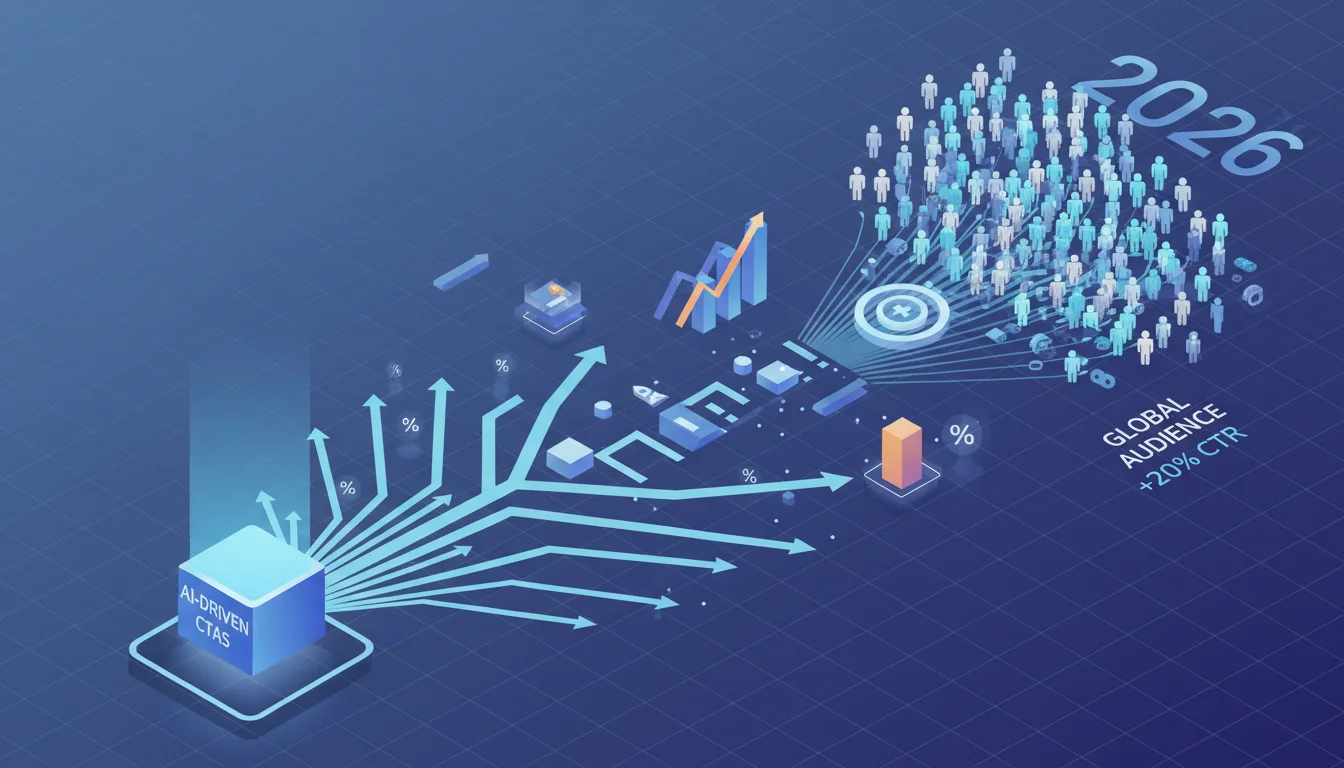
- AI tools dig into user behavior and contextual data to create personalized CTA copy, which can boost click-through rates by up to 20% over generic ones.
- You can run constant A/B testing with AI CTA platforms to find the best language, placement, and visual design for different audience segments, letting the system optimize itself.
- Integrating AI CTAs with your CRM and marketing automation software makes dynamic content delivery possible, getting the right message to the right user at just the right moment.
- The best AI-generated CTAs use clear, value-driven language. Cut the jargon and just tell the user what they get right now.
The Evolution of CTAs: From Static to Dynamic
For a long time, CTAs were static. We designed them using general marketing ideas and what we assumed about our audience. Buttons like “Click Here” or “Learn More” did a job, but they were blunt instruments, unable to adapt to what a specific user wanted in that moment. The digital environment in 2026 requires a personalized invitation that connects with a user’s immediate needs, and that’s what AI delivers, turning passive buttons into active, persuasive prompts.
Just think about the sheer amount of data that users generate across websites, social media, and emails. Trying to manually turn all that information into better CTAs is impossible. AI, on the other hand, chews through this data at scale, spotting subtle patterns in behavior and preference. For instance, an AI might learn that a user who hangs around a product page for 30 seconds without buying is more likely to click a CTA offering a limited-time discount. At the same time, it might see that a user who just skims a blog post will respond better to a CTA for a downloadable guide. This kind of granular insight was impossible to get without some serious algorithmic horsepower.
AI-powered dynamic CTAs are all about predictive analytics. They analyze historical data on demographics, browsing history, past purchases, and even what a user is doing in their current session to predict their next move or find the best message to get them to act. This isn’t just a shot in the dark, it’s statistics. A late 2025 report from eMarketer predicted that global spending on AI in marketing would blow past $50 billion by 2026, with a huge chunk of that going to personalization tech like AI CTAs.
How AI Crafts Persuasive Copy
AI’s real strength in generating CTAs is its ability to analyze the nuts and bolts of language and psychology, going way beyond what a simple A/B test can tell you. Natural Language Processing (NLP) models and machine learning algorithms sift through millions of successful and failed CTAs to learn what makes a phrase stick. This means understanding word choice, sentence structure, and emotional triggers.
An AI can figure out that for a B2B SaaS product, CTAs on case study pages work best when they talk about “efficiency gains,” while CTAs on feature comparison pages should focus on “smooth integration.” That context is everything. What’s more, these systems can spit out hundreds of CTA variations at once and test them in real-time on different audience segments. This constant feedback loop lets the AI get smarter and smarter about what works, an iterative process that’s far more efficient than any manual testing a team could do on their own.
Imagine your marketing team is getting a new email campaign ready. Instead of spending hours brainstorming ten CTA options, an AI tool can generate hundreds, each one tailored to a specific segment of your email list based on their past behavior. These AI-generated CTAs could have different lengths, tones (authoritative, friendly, urgent), and value props. The system then deploys them, tracks everything, and tells you which ones are winning. It’s a level of precision that a human copywriter alone just can’t achieve.
Key Elements AI Optimizes in CTAs:
- Word Choice: The AI finds the verbs and power phrases that actually convert for specific user groups, learning the impact of emotional words and scarcity language.
- Sentence Structure: The system optimizes for short, punchy CTAs or more descriptive ones, depending on the context and who you’re talking to. Is a quick “Buy Now” better than “Get Your Complete Toolkit”? The AI finds out.
- Personalization: This goes way beyond just inserting a first name. AI can change the entire message to reference what a user has done, making the CTA feel personal. For a streaming service, “Continue Watching Your Series” is infinitely better than a generic “Watch Now.”
- Placement and Design: While the AI doesn’t design the button itself, it analyzes user heatmaps and behavior to recommend the best placement, size, and color to support the copy it just wrote.
- Urgency and Scarcity: AI can intelligently add phrases like “Offer ends today!” or “Only 3 left!” based on real data like inventory levels or promotion schedules, creating urgency without lying to the user.
Implementing AI in Your CTA Strategy
Putting AI into your CTA strategy requires a methodical approach. The first thing you have to do is audit your data sources. AI needs good, clean data to work, so making sure your CRM, analytics platforms, and marketing automation tools are all talking to each other and collecting complete user profiles is the foundation. Without it, the AI is flying blind.
Next, find the specific spots where your CTAs are failing or where you know you can get a big lift. This could be on product pages, blog posts, or in a specific email drip campaign. Start with a small pilot project to prove the value. For example, you could pick one underperforming email sequence and use an AI copywriting tool like Copy.ai or Jasper to generate a bunch of new CTA variations for your key segments. These tools often plug right into email service providers, which makes deployment and testing pretty straightforward.
It’s also critical to set clear metrics for what success looks like. Are you trying to jack up your click-through rate (CTR), your final conversion rate, or the average order value? You have to define these KPIs before you start so you can actually measure the impact. Keep an eye on performance and be ready to iterate. AI models get better over time as they get more data, so your initial results will likely get even better as the system refines its predictions. In my experience, teams that give this at least three months of continuous, AI-driven optimization see the biggest and most lasting improvements.
Challenges and Considerations
While AI CTAs have obvious benefits, they also come with challenges. Data privacy and ethics are at the top of the list. As you start gathering and analyzing huge amounts of user data, you absolutely have to comply with regulations like GDPR and CCPA. Being transparent with users about how you use their data and giving them clear opt-outs is a legal requirement and also just good business for building trust. A 2025 IAB report on AI and privacy confirmed that consumers increasingly expect control over their data, and brands that ignore this are risking their reputation.
Another thing to watch for is AI-generated copy that sounds bland or robotic if you don’t keep an eye on it. AI can create incredibly effective CTAs, but a human still needs to be in the loop. A good copywriter should review the AI’s suggestions, tweak them to fit the brand’s voice, and make sure they fit the overall marketing message. AI is a powerful assistant that automates the grunt work of generating and testing endless variations, which frees up your marketers to think about strategy and creative direction.
Finally, the cost of these advanced AI tools can be a real barrier, especially for smaller companies. Many platforms have tiered pricing, but the investment to integrate them and get them running smoothly is real. The potential return on investment (ROI) from higher conversion rates often makes the cost worth it, though. When you’re looking at different AI CTA platforms, think about the long-term value from better efficiency and measurable conversion gains. It’s a strategic investment.
The Future of Conversion Optimization with AI
The future of AI in conversion optimization is all about creating more sophisticated, hyper-personalized interactions in real time. We’re getting to a point where we can optimize the entire user journey, not just the text on a button. Imagine an AI sees a user hesitating on a checkout page. Instead of showing the same “Complete Purchase” CTA, the AI could instantly offer a small, personalized discount, suggest a related product, or even trigger a live chat with a support agent based on that user’s specific behavior. This adaptive approach is going to completely change how businesses interact with customers.
On top of that, integrating AI with augmented reality (AR) and virtual reality (VR) will create totally new kinds of CTAs. In a VR store, a CTA might be an interactive object that invites you to “Try On This Outfit in AR” or “Experience This Product in VR.” The possibilities are huge, but the core idea is the same: use data and intelligence to make every call-to-action as relevant as possible for that one person.
The future of conversion optimization is tied directly to AI’s progress. The marketers who get on board with these tools now will have a serious competitive edge, turning their broad-stroke campaigns into a series of highly targeted, effective conversations. The whole game is shifting to personalized invitations.
Using AI for persuasive CTAs means getting past old methods and using intelligent systems to respond to what individual users want. The way to start is by integrating your data, running a pilot program with an AI tool on a specific campaign, and constantly tweaking your approach based on what the performance data tells you. This is how you’ll get real, tangible improvements in your conversion rates.
What is an AI CTA?
It’s a call-to-action that’s been generated or optimized by an artificial intelligence program. The AI analyzes user data and context to create personalized and persuasive prompts that are built to maximize clicks and conversions.
How does the AI personalize a CTA?
It analyzes data about an individual user, their browsing history, demographics, past purchases, and what they’re doing on your site right now. It uses that info to tailor the words, the offer, and even the placement of the CTA to match what that user is most likely to respond to.
Will AI replace human copywriters for CTAs?
No, it augments them. AI is a powerful tool that can generate thousands of variations and run tests at a speed no human could match. This frees up copywriters to focus on high-level strategy, brand voice, and adding the final creative polish to the AI’s best ideas.
What kind of data does AI need to optimize CTAs?
For effective CTA optimization, an AI needs clean, complete data from all your sources. This includes your CRM, website analytics, email marketing platform, and ad platforms. The data should cover everything from user demographics and behavior to purchase history and engagement.
What are the biggest benefits of using AI for CTAs?
The main benefits are much higher click-through and conversion rates because of the hyper-personalization. You also get huge efficiency gains in testing, deeper insights into what your users actually want, and the ability to scale that personalization across your entire audience.


