 By Editorial Team
Almost half, 47% of marketing pros worldwide, are already using AI for content, according to the Statista Global Consumer Survey 2023-2024. That’s a huge shift, and it’s creating real problems for authentic branding and exec comms. The real test is making sure the AI’s output actually connects with people instead of just sounding like a machine.
Key Takeaways
- Consumer trust in AI content is rock-bottom at 18% compared to human work, so you’ve got to be careful or you’ll torch your brand’s credibility.
- If your AI content sounds generic and misses your brand voice, expect engagement to drop by as much as 30%.
- For any exec-level comms using AI, you need a human involved at least 70% of the time to get the nuance, empathy, and strategy right.
- You absolutely need a “human-in-the-loop” protocol. A human editor must review and fix every single thing the AI spits out to keep it authentic.
- Focus on AI tools you can heavily customize, think tone, style, and persona, so they can actually match your brand’s guidelines.
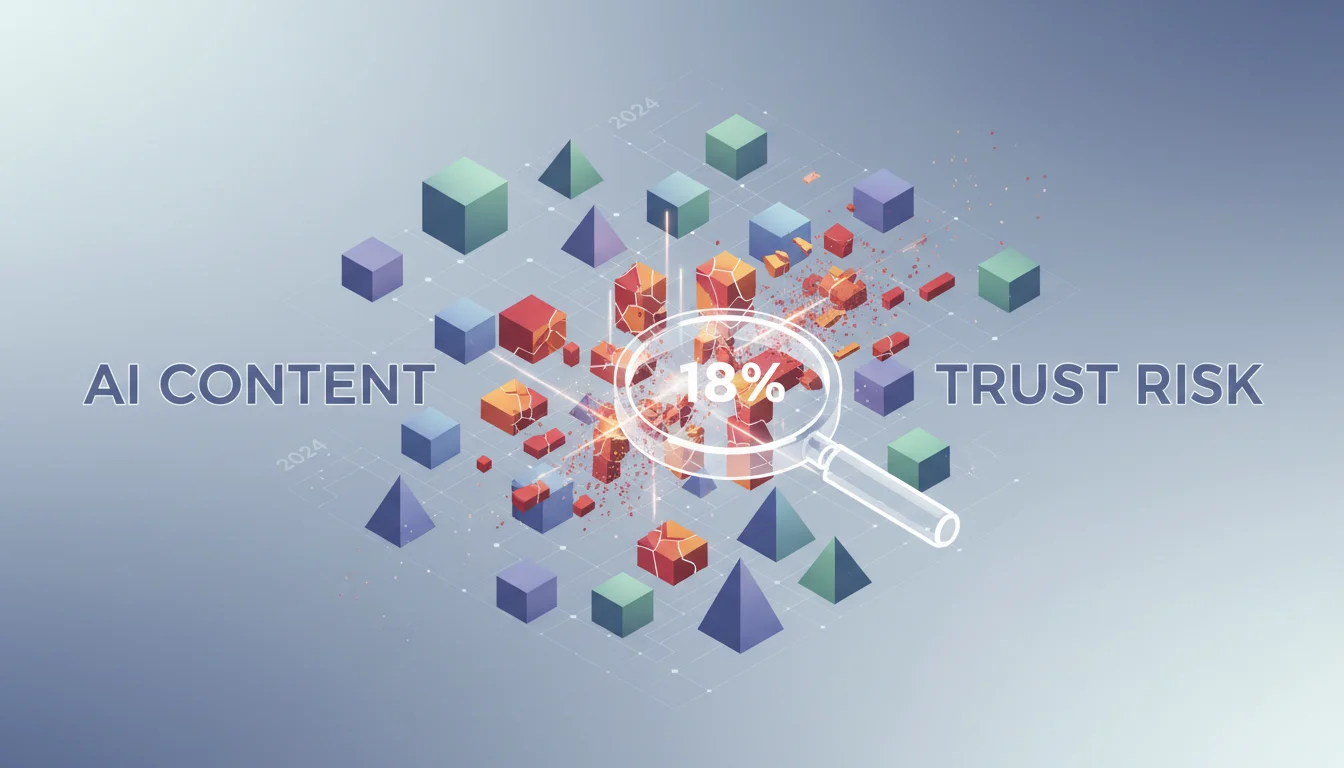
Only 18% of Consumers Trust AI-Generated Content as Much as Human-Created Content
HubSpot’s 2024 AI Report gives us a brutal number: only 18% of people trust AI content as much as human work. That’s a huge trust gap. I see it all the time, readers can just *feel* when something’s missing the human touch, the empathy, the weird little quirks that make a brand’s perspective unique. For any marketer, this should be a flashing red light. Trying to win by just cranking out massive volumes of AI text is a game you’ll lose. Your job is to generate content that builds and sustains trust. If you just dump unedited AI posts onto your channels, you’re going to push people away. Think about it from a local perspective: if a financial advisory firm in Midtown Atlanta puts out market updates that sound robotic and lack any real analysis of the local scene, their clients are going to doubt the advice itself, even if the numbers are correct. This problem gets even worse for executive comms, where a CEO’s message that feels machine-written has zero power to actually lead or inspire anyone.
Brands Risk a 30% Decline in Engagement if AI-Generated Content Lacks a Distinct Brand Voice
If your AI content is generic, you can expect engagement to plummet by 30%, a stat pulled from eMarketer’s 2025 Digital Marketing Trends report. This makes perfect sense. Companies spend years and a ton of money building a specific voice, maybe it’s the confident authority of a Georgia workers’ compensation law firm or the witty chatter of a startup. Generic AI-generated text just washes all that away. The issue is that AI struggles to nail the subtle stylistic habits that make a brand feel like a brand. How many times have we seen a company with a fun, irreverent voice try using AI for a blog, only to get something that sounds like it was written by a committee of accountants? The fix is to train AI models extensively on existing brand assets. That means feeding it your best-performing campaigns, your executive speeches, and especially your internal style guides. You have to fine-tune the model with a bespoke approach, not just use generic prompts. If you don’t put in that work, your AI content will actively harm the connection you’ve tried so hard to build with your audience.
| Factor | AI-Generated Content | Human-Created Content |
|---|---|---|
| Consumer Trust Level | 18% (as much as human) | Higher (implied benchmark) |
| Engagement Risk (Generic Voice) | 30% Decline | Maintains/Builds Engagement |
| Human Oversight for Executive Comms | 70% Minimum Required | Integral, inherent |
| Impact on Brand Credibility | Potential risk without careful integration | Preserves and builds credibility |
| Content Generation Strategy | Volume-focused, risks alienation | Trust-building, nuanced |
Successful Executive Communication Using AI Requires a Minimum of 70% Human Oversight
A top B2B marketing agency that works with Fortune 500s found that successful executive comms using AI needs at least 70% human oversight. This number points to a basic reality of high-stakes messaging. A message from a leader is about leadership, vision, and empathy. An AI can assemble the facts for a quarterly report, sure, but it can’t fake a CEO’s personal conviction about employee well-being after a tough quarter, nor can it explain the strategic thinking behind a huge acquisition with the authority of someone who was actually in the room for the negotiations. In my experience, human judgment is indispensable for final approval on anything that could move stock prices, affect employee morale, or change public opinion. The workflow is usually AI drafting an outline or some copy, followed by a human comms pro who tears it down and rebuilds it with the executive’s real voice and strategic purpose. This is editing for soul. A message from Emory University’s President about a new campus project, for example, would need a massive amount of human work to make sure it hits the right notes with students, faculty, and big-money donors.
Conventional Wisdom Says: “AI will replace copywriters.” I Say: AI will redefine their role.
The popular take is that AI will kill the copywriter. That’s a shallow and completely wrong-headed view. From what I’ve seen working with dozens of marketing teams trying to figure this out, AI acts as an accelerant and an enabler. The copywriter’s job is just changing. They’re shifting from banging out first drafts to being editors, strategists, and guardians of the brand voice. Instead of grinding out 50 product descriptions, a writer can now focus on the high-level campaign narrative or a deep-dive content strategy, while also making sure every piece of AI content is on-brand. They are the essential “human-in-the-loop” the data keeps pointing to. This means learning new skills, of course: prompt engineering and real proficiency with the tools are table stakes now, along with an even sharper sense of brand identity. The smartest copywriters I see are already using AI to automate the grunt work so they can save their brainpower for the work that actually matters.
2026 AI Tools Offer Advanced Personalization, but Human Curation Remains Paramount
Today’s AI platforms like ChatGPT Enterprise and Jasper are getting incredibly sophisticated with personalization, using audience data and even real-time behavior to customize content. The AI can theoretically write one message for a new customer in Buckhead and a totally different one for a long-time client over in Alpharetta, or switch from Gen Z slang on TikTok to a more formal tone for Boomers on LinkedIn. This is obviously efficient, but authenticity is still the name of the game. Why? Because personalization without a genuine connection just feels manipulative and creepy. I’ve seen it happen: a company gets so excited about hyper-personalization that the content starts to feel intrusive instead of helpful. A human editor’s job is to be the gatekeeper, making sure every personalized message feels organic and genuinely valuable. They have to check the tone and the vocabulary to guarantee it connects with that specific person or group. The tech provides the scale, but a human has to provide the soul.
So, bringing AI into your content and executive comms is a question of *how*, not *if*. All the data we have shows a future where AI makes humans better at their jobs. The way to make this work is by being obsessed with authenticity, keeping a human editor involved in everything, and remembering that technology is a tool for amplifying real human connection, not faking it.
How do you keep AI content authentic?
You need a strict “human-in-the-loop” review process. A person must review every piece of AI content to align it with brand voice guidelines, add unique insights, and check for emotional tone. It’s also smart to train your AI models on your own brand’s materials and style guides.
What’s the risk of using raw AI content for an executive’s message?
You risk losing trust with everyone, investors, employees, the public. The executive’s leadership will seem weak, and the message will feel hollow. A robotic message from a leader undermines their authority and can’t inspire or reassure anyone.
What new skills do writers need for the AI era?
They need to get good at prompt engineering and master the AI tools themselves. Beyond that, they need skills in data analysis to see what’s working and an even stronger grasp of brand strategy and audience psychology. The job is shifting to strategic oversight and high-level editing.
Can AI really copy a unique brand voice?
It can get close, but it almost always misses the subtle stuff, the specific humor, the tone, the emotional texture that makes a brand’s voice feel unique. A human editor is still the only way to add those final, important elements and make sure the voice is consistent.
Can AI personalization hurt consumer trust?
Absolutely. It can make things more relevant, which is good. But if it gets too personal and feels creepy or manipulative, it will destroy trust. The point is to use personalization to add real value, not just to target someone, and you need a human to make that judgment call.


